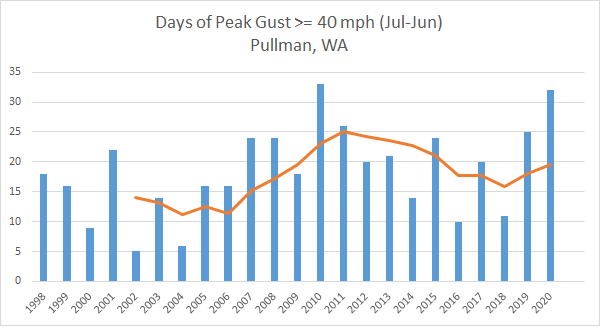
Looks like just about every year has 1 to 3 events with wind gusts over 50 mph. And 2020-21 was no different, with a total of 3 events. Notice, though, that there have been years with a few more windy days in Spokane. 2011-12 had 5 such days. And looking back much further, the winter/spring of 1970-71 had 6 days with 50 mph or more, and 1971-72 had a rather amazing 12 such days.
Friday, October 29, 2021
Does it seem like it's getting windier in the Inland NW?
Looks like just about every year has 1 to 3 events with wind gusts over 50 mph. And 2020-21 was no different, with a total of 3 events. Notice, though, that there have been years with a few more windy days in Spokane. 2011-12 had 5 such days. And looking back much further, the winter/spring of 1970-71 had 6 days with 50 mph or more, and 1971-72 had a rather amazing 12 such days.
Saturday, October 16, 2021
Firestorm 1991
This Day in History!
Today marks the 30th anniversary of the event knowns as "Firestorm" in the Spokane Area. This event was characterized by a dry spell that occurred from late August through early October. The fall rains were late to arrive with fuels crispy dry and able to carry fire very easily. The event itself was driven by a strong cold front that produced extreme southwest winds with numerous ignitions from downed powerlines. Multiple fires broke out that quickly overwhelmed initial attack as strong winds fanned flames all across the Spokane Area. In this blog, we will re-visit Firestorm: news articles chronicling the event, the antecedent conditions, and of course the meteorology.
"Northern Spokane County like war zone"
Here is a portion of an article courtesy of the Spokesman Review detailing the conditions that day.
| Article courtesy of Spokesman Review |
- 114 homes destroyed
- 2 fatalities
- 50,000 acres burned
- 80 fires
| Spokane International Airport observations for October 16th, 1991 from 7 AM to 7 PM PDT |
Thursday, July 29, 2021
Record Hot July, Rain Anyone?
If you are hoping for some rain, we have good news for you! But before we get there, another heat wave is about to hit the Inland Northwest which isn't good news for the ongoing drought.
Here is the latest U.S. Drought Monitor released today, July 29th. Exceptional drought (D4) was covering a large portion of Eastern Washington and north Idaho.
| U.S Drought Monitor released July 29th, 2021 |
![]() |
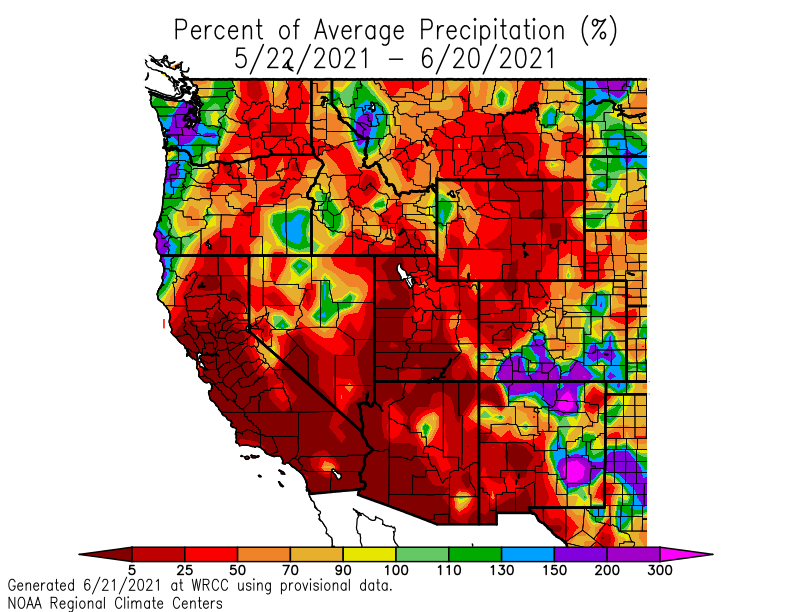
| Percent of normal precipitation past 6 months |
| Evening satellite - July 23rd, 2021 courtesy of UW |
Making matters worse has been the hot July, with temperatures over most areas running 4 to 8 degrees above normal so far this month.
And another heat wave is likely as we close out the month of July. On Friday many locations will reach the triple digits, with the heat peaking on Saturday with near record high temperatures for the day. Here the forecast high temperatures for Saturday as of this writing
![]() |
| NWS Forecast High Temperature for Saturday, July 31st, 2021 issued 230 PM July 29th |
.
These temperatures will equate to many areas nearing, or exceeding their all time warmest July on record. Here are some locations that have a good chance of the hottest July, with observed average temperatures for July 2021 so far shown.
Spokane Airport (GEG)
Bonners Ferry, ID
Lewiston, ID
Wenatchee Airport, WA
Omak, WA
Changes Ahead!
After all this talk of heat, fires, and drought, let's shift gears and talk about changes this weekend. Some surfaces may look like this by Monday.
Yes, we have rain to talk about! Models are pretty consistent in showing an increase in moisture moving up into our region. This animation below (courtesy of College of DuPage) shows available moisture (also called precipitable water) and is NOT a rainfall forecast. It's more of an indicator of available moisture for rain.
![]() |
| 12z July 29th GFS run of Precipitable Water Standardized Anomaly valid July 29-Aug 3, 2021 |
Note that as values reach the blue and purple shadings on Sunday and Monday that it corresponds to the highest end of the legend at the bottom of the graphic. This means there will be close to the highest amount of available moisture over our area as we can get for this time of year.
But the big question is will this lead to an abundance of rain and will there be thunderstorms? We think most areas will get some rain, but amounts are uncertain. This is due to the convective hit and miss nature of showers and thunderstorms. Here is one ensemble forecast for rain totals for Coeur d'Alene, ID.
| 12z July 29th GEFS forecast of precipitation for Coeur d'Alene, ID through August 3rd, 2021 |
![]() |
| Climate Prediction Center 6-10 day Precipitation Outlook valid Aug 4-8th, 2021 |
Saturday, July 3, 2021
How hot did it really get in Spokane on 29 June 2021?
After our historic heat wave of 2021, it's time to take a look back and answer the question of just how hot did it really get in Spokane on June 29th. Unfortunately, the answer does get a little sticky. First we need to look back in history, as well as look at the topography of Spokane.
Temperature measurements in Spokane started in 1881, and these were taken in downtown Spokane. The Weather Bureau office moved out to Felts Field in 1941, and with it, the official temperature of Spokane moved as well. Observations were still taken in downtown Spokane, they just were no longer official. Six years later, the Weather Bureau moved again, from Felts Field to Geiger Field (which would later become Spokane International Airport) on the West Plains of Spokane. The official observation for Spokane has been at the airport since 1947.
Moving the observation from downtown to Felts Field probably didn't have much of an effect on the temperature readings. Both locations are at about the same elevation. But in the 1940s, the area around Felts Field was more rural than downtown, so there may have been a little less "urban heat island" effect. However, the move to the West Plains in 1947 was significant. The elevation of downtown Spokane is about 1890' above sea level. Felts Field is at the 1953 foot elevation. But the Spokane International Airport is up at 2356 feet, an increase of nearly 500 feet. Using the thumb rule of 5.5 degrees per 1000 feet, that results in a difference of about 2.5 to 3 degrees between the West Plains and downtown.
It's important to note that downtown Spokane is about the lowest elevation of the entire metro area. 57th Avenue on South Hill is at about 2360', which is the same elevation as the airport. Same goes for Five Mile. Even I-90 at Stateline is at about 2100'. So your location in the metro area has a big effect on your temperature, just from the standpoint of elevation.
Additionally, your surrounding environment also has an effect on your temperature. If you're downtown with lots of concrete and asphalt, the temperature is probably a few degrees warmer than if you're near the river or at a golf course.
Late July of 1928 was extremely hot across the Inland Northwest. Triple digits were common just about everywhere for several days. For many locations, July 26th 1928 became the hottest day on record at the time. Prior to this event, the hottest temperature on record at Spokane was 104F, set in 1898. That mark was tied on July 24th and 25th of 1928, after a 102F on the 23rd. On the 26th, temperatures peaked as Spokane hit the 108F mark. Some other extreme readings on that day included:
- Omak - 114F
- Ephrata - 112F
- Lewiston - 113F
- Orofino - 114F
- Walla Walla - 113F
Additionally, 1961 set the record for the hottest day in Washington state history, with a reading of 118F at Ice Harbor Dam (along the Snake River just east of Tri Cities).
So now we return to present day Spokane, and the 2021 historic heat wave. We all know by now that Spokane Airport hit 109F, setting the all-time record for the city. But was that truly the temperature that the citizens experienced? After all, there's not many people who live at the Spokane Airport. Thankfully, we now have a number of temperature measurements available to us to answer that question.
So while it was 109F on the West Plains, it was 113F at Felts Field. So perhaps that should be the official temperature observation for Spokane during this heat wave? Is that what most people experienced? But then you notice that it there's quite a range of temperatures around the metro area. It was 115F along I-90 in Spokane, but 108F near High Drive, and only 106F in Opportunity/Spokane Valley. So perhaps the 109F at the Spokane Airport is a decent "middle of the road" temperature for the area.
For a bit broader view, several locations set their all-time high temperature record in the Inland Northwest on June 28th.
- Omak: 117F, old record 114F (26 Jul 1928)
- Wenatchee: 113F, old record 110F (18 Jul 1941)
- Bonners Ferry: 108F, old record 105F (11 Aug 2018)
- Chelan: 111F, old record 110F (29 Jun 2015)
- Davenport: 107F, old record 105F (26 Jul 1928)
- Mazama: 112F, old record 103F (1 Aug 2020)
- Northport: 113F, old record 110F (28 Jul 1934)
- Odessa: 115F, old record 112F (4 Aug 1961)
- Plain: 109F, old record 104F (27 Jul 1939)
- Priest River: 108F, old record 105F (10 Aug 2018)
- Republic: 109F, old record 108F (2 Jul 1924)
- Rosalia: 111F, old record 108F (27 Jul 1934)
- Sandpoint: 106F, old record 104F (24 Jul 1994)
- Wilbur: 110F, old record 110F (3 Jul 1922)
But not every location set all-time records. Coeur d'Alene hit 108F for 2 consecutive days in this heat wave, but both fell short of their all-time record of 109F in 1961). A similar story for Grand Coulee Dam. Moscow and Pullman fell 4 degrees short of their 1961 record.
Daytime high temperatures weren't the only records broken. The nighttime temperatures were rather uncomfortable as well. Spokane airport also set an all-time record for warmest low temperature. It tied the record on the morning of the 29th, cooling only to 77F. This equaled the record set back on 27 July 1928. After topping out at 109F during that afternoon, the temperature was only able to cool to 78F by the morning of the 30th, setting the all-time record.
The all-time high temperature record for Washington of 118F may have been tied or even broken at a few different locations during this recent heat wave. A climate extremes committee will review this in the coming months.
Wednesday, June 23, 2021
We are forecasting the hottest day ever in Spokane history
A heat wave like no other is becoming increasingly likely. Prepare NOW!
The biggest heat wave to ever strike the Inland NW on record is becoming increasingly likely. What makes this event unique?
- All time record high temperatures are in jeopardy for several locations
- And this is during June (our peak heat season is late July through early August)
- 100+ degree temps will last for several days
- Mild overnight lows in the mid 60s to upper 70s will provide little to no relief at night
- Occurring during a period of severe to extreme drought
- Fire danger increasing to record levels next week and as we near the 4th of July (for this early in the season)
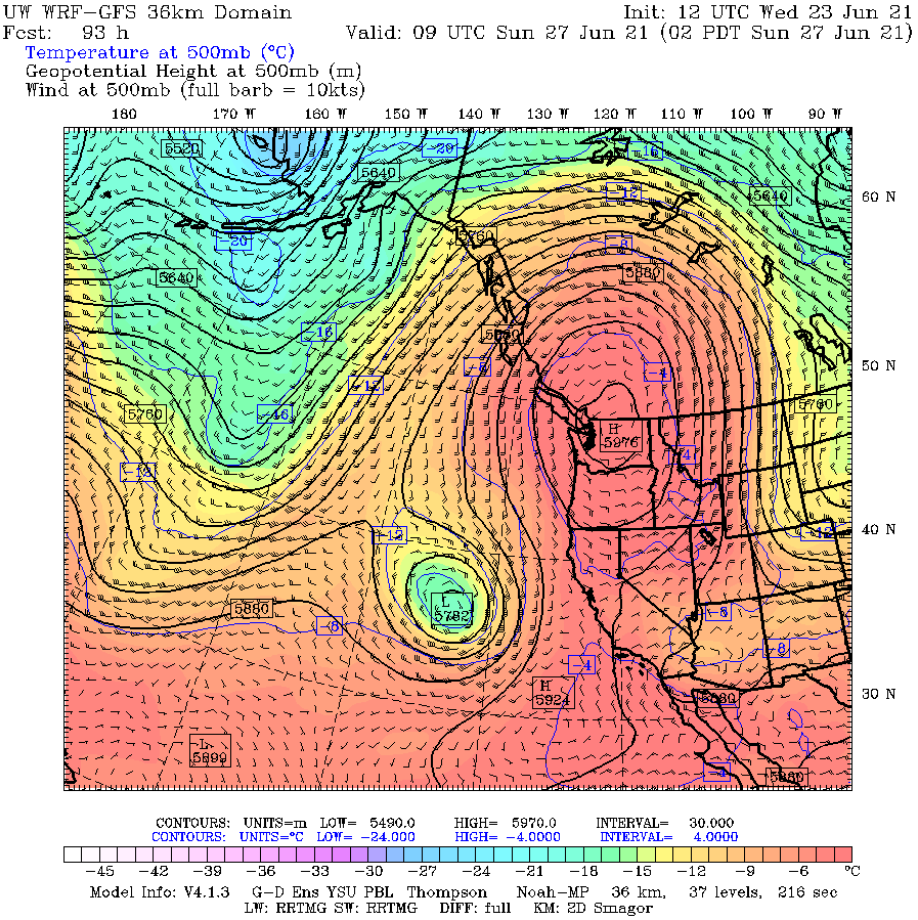
| 12z GFS model of 500mb heights, winds, and temperatures valid 2 AM PDT Sunday, June 27th 2021 |
Strong high pressure in late June spells trouble! Why? The lower atmosphere continues to warm as the ridge persists over the region as the late June sun angle brings an abundance of solar radiation towards the Earth's surface which continues to warm things up each day. Here is one model prediction of near surface temperature anomalies from this Thursday through the following week (June 24-July 3rd).
![]() |
| NWS Forecast High Temperature for Monday, June 28th (issued June 23rd) as compared to current all time records. |
And if we don't break the all time records on Monday, we will probably have another shot on Tuesday and Wednesday! Here is our current forecast as of June 23rd for Tuesday.
| Meteogram of forecast raw model temperatures for GEG (Spokane International Airport) through Wednesday, June 30th, 2021 |
| Meteogram of forecast raw model temperatures for Moses Lake through Wednesday, June 30th, 2021 |
While these values are not currently forecast, it does have our attention. The record for the state of Washington and Idaho is 118 degrees at Ice Harbor Dam, WA and Orofino, ID so we will be watching for this potential closely.
And what about fire danger? Fuel moisture is expected to dry out considerably, reaching record low values for late June. Fuel moisture comes in different sizes, but all are measures of how dry the grass, twigs, branches, and timber are.
- Drink plenty of fluids and wear light colored clothes
- Check on and take care of those vulnerable to heat (children, those with chronic medical conditions, elderly, pets)
- Stay inside during the hottest times of the day (afternoon and early evening)
Monday, June 21, 2021
Heat is On The Way!
This week it will be hot and dry for most of the Inland Northwest and the Pacific Northwest. Seeing some of the model guidance and predicted temperatures for this week and next weekend reminded us of the June 27-28 heatwave of 2015 (you can read our blog post here). Let's dive into the comparisons of this heatwave vs 2015 and lay out the expected forecast for this week.
We talked earlier this month about our record dry spring, and in the last 30 days the story of very dry conditions continues. Many locations did receive some good rain from the thunderstorms of June 15th. But the total amount of precipitation in the Inland Northwest has been very low. For many places, around 25% of average or lower.
Here’s a look at our normal precipitation for May and June (since June isn’t complete yet, we went back into May) shown by the brown line, what we have accumulated on the green line, and compared this to 2015 since we know that year saw a hot spell in June. We can see that compared to 2015, this year (2021) is drier for the May - June period.
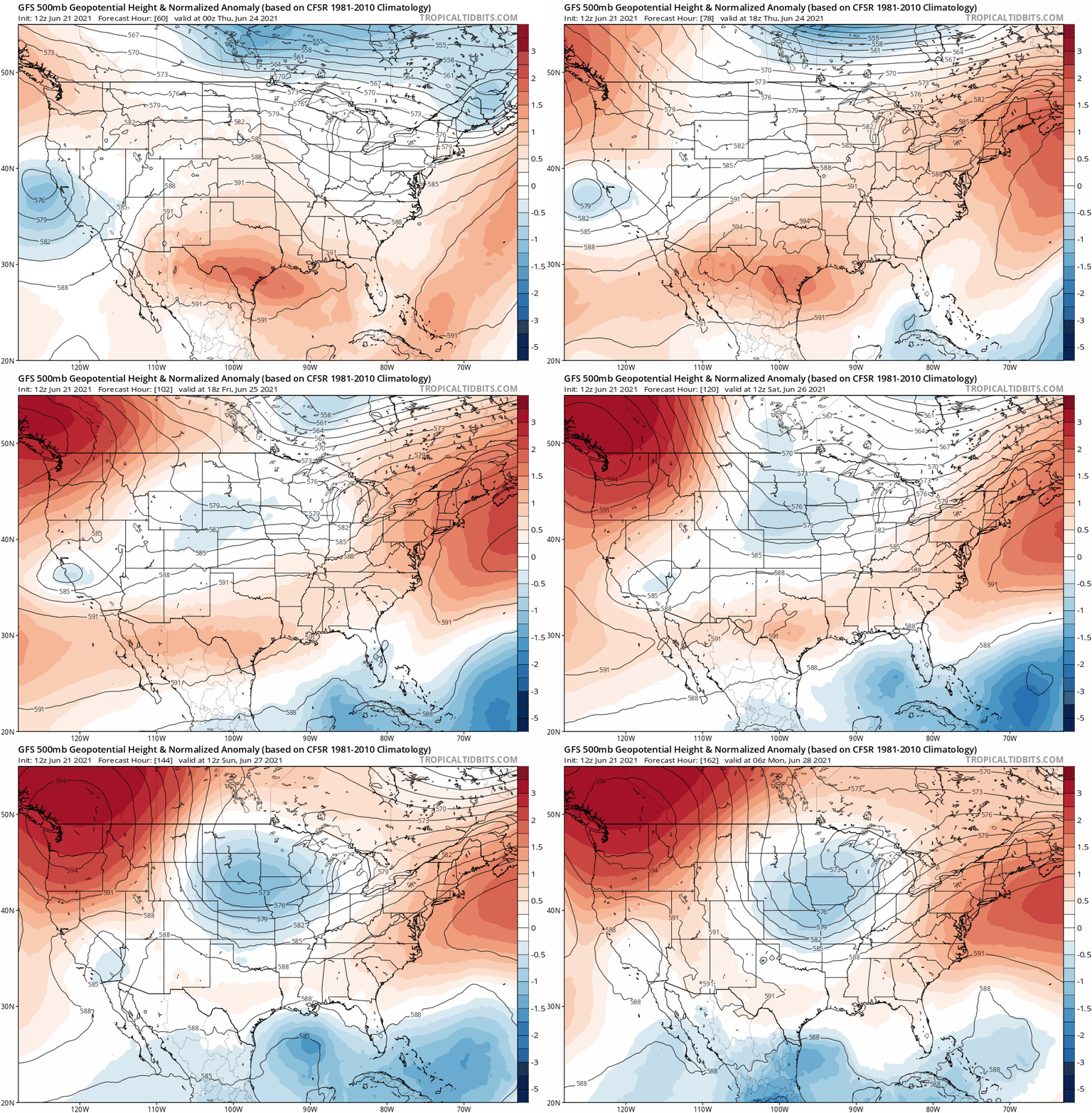
Taking into consideration the very dry spring and now start to summer, along comes a strong ridge of high pressure that will continue to strengthen and settle over the northwest. Below is a loop of the 500mb heights and anomaly from the GFS model, Thursday through next Monday. For this weekend and early next week, extremely strong high pressure will dominate southwest Canada and the northwest US.
For June in eastern Washington (we’ll use Spokane International Airport as a point of reference), the normal high temperature is 74F. This week, we’re looking at temperatures 10 to 25F degrees above normal, or higher. Yes, higher. By next weekend, daytime temperatures in the 100-105F range are possible. This kind of heat hasn’t been seen since 2015, and thus why we look back to 2015 to see what kind of conditions were going on and what the models were saying then, giving us an idea of what might be to come this week and weekend.
Putting this into perspective, the record hottest temperature ever for Spokane is 108F set on Aug 4, 1961.
Going back to the comparison of 2015, June 27-28 saw temperatures of 102F (27th) and 105 (28th), with upper 90s on days leading up to and after that heat wave. The afternoon of June 28th, the 850mb temperature was 29.6C giving us that max temperature of 105F. What do the models say for our 850mb temps this week and next weekend? Below is the sounding climatology from SPC for Spokane (OTX) for 850mb temperatures. The all-time max 850mb temperature is 31.5C from early August.
Current deterministic model guidance for 850mb temperatures are quite jaw-dropping:
ECMWF:
Saturday - 28.85C
Sunday - 30.85C
Monday - 33.85C
Tuesday - 35.3C
Wednesday - 32.0C
GFS:
Saturday - 28.3C
Sunday - 29.7C
Monday - 33.2C
Tuesday - 34.5C
Wednesday - 33.3C
So all around very hot temperatures for this weekend and into early next week. Leading up to Sunday, the ridge strengthens Friday through Sunday with Sunday looking like the hottest in the next 7 days, which is as far as our forecast goes out at this time.
What about beyond Sunday? Forecast model guidance gets tricky the farther out in time, however strong high pressure patterns are ones that have a tendency to be more persistent, so confidence isn’t completely out the window with the idea that this heat could last into the middle part of next week. Ensemble guidance has also been very consistent in highlighting this strong ridge through early next week. The suite of models are showing 850mb forecast temperatures next Tuesday of 33C - 35C. We have many days between now and then, so these numbers may fluctuate a bit but this is something to keep in mind.
In 2015, we observed 4 days of maximum temperatures 100+F, and in 2020 we observed 3 days (the most is 6 days set in 1928).
The Climate Prediction Center is highlighting a high percentage of excessive heat for June 29-30, next Tuesday and Wednesday. This would suggest our ridge has lower chances of breaking down and better chances of this heat to persist into the middle part of next week.
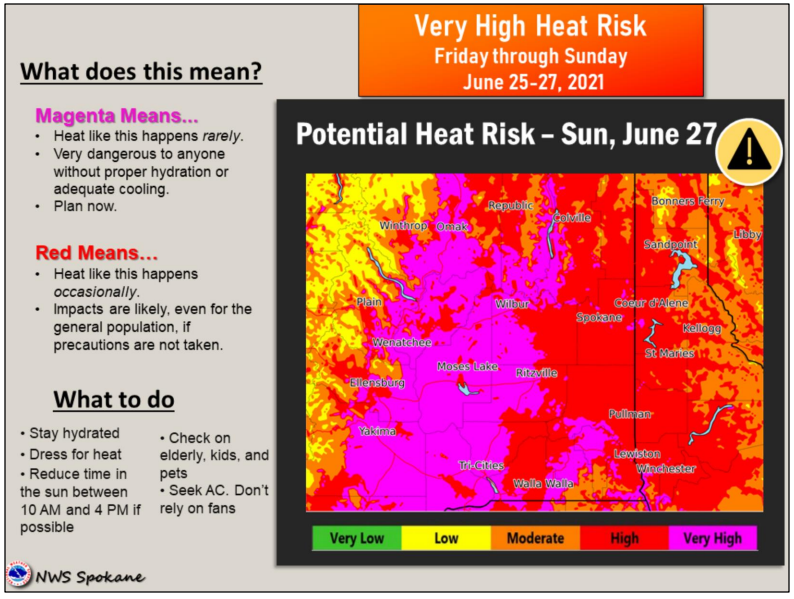
Other factors we have to take into consideration are the overnight low temperatures. With such strong heat during the day, the overnight relief may become less of a relief. Together, this will increase our heat risk for various populations in our region. Currently, here is a snapshot of our heat risk forecast.
Our confidence is fairly high that we will see this prolonged heat last into early next week with this upcoming weekend seeing the hottest temperatures of the year, the hottest since 2015, and the hottest in the next 7 days. After that, it’s possible we will see continued hot temperatures and perhaps slightly hotter?