Friday, November 15, 2019

The persistent ridge - A look back and forward

Curious what this winter will bring?  In past years we have written a blog about the winter outlook in late September or October, but this winter prediction has been a challenging one.  Let's begin with the weather pattern since last February.

500mb height anomalies for selected time periods since February 2019
 
Lots of colors to look at.  The screaming message has been the persistent ridge in the eastern Pacific.  It has had varying magnitudes and placement but has been there in some way, shape, or form since February.  Last February and March it was very amplified bringing cold and snowy weather to our region.

Over the summer the ridge allowed weather systems to drop down into the area with the # of 90 degree days much lower compared to the past five years.


And then this past October was noteworthy with the coldest October for many across the Inland NW.


Now it's November, and the very amplified ridge has given us a very dry start to the month as well as much of the western US.


It does look like a weather system will track into the area early next week (Nov 17-19th) time frame bringing rain and high mountain snow.  Here is the Nov 18th pattern showing a low off the WA/OR coast with the jet stream over the area.
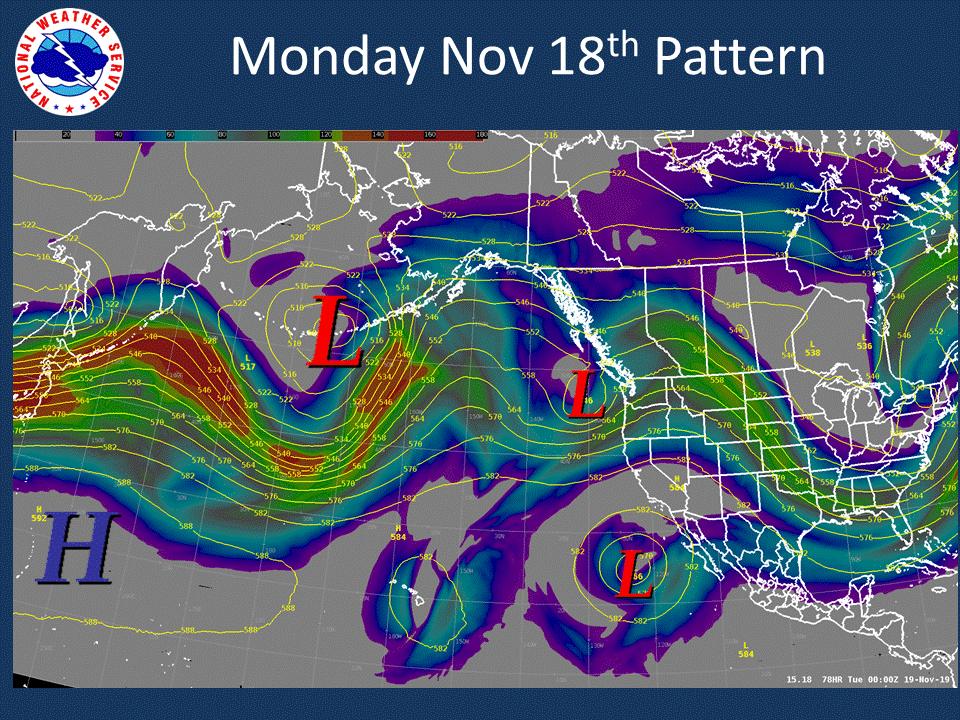
12z Canadian model forecast of 500mb heights and 250mb winds (image) valid 4 PM PST Nov 18th, 2019

Don't expect this to be a long lasting change.  The ridge returns Wednesday and will probably last through the rest of the week.

12z Canadian model forecast of 500mb heights and 250mb winds (image) valid 4 PM PST Nov 20th, 2019

So the persistent ridge - what does it mean for this winter?  We are looking at a neutral year (neither El Nino or La Nina), which typically brings a lot of variability for our winter weather.  But on average, this is the pattern that sets up

Typical weather pattern for ENSO-Neutral years

Typically active weather sets up as a Pacific Jet Stream takes aim at the area.  With this said, it's interesting that several climate models want to give us a wet December.  Here is what the average of the models (NMME forecast) shows.

NMME model forecast of precipitation anomalies Dec 2019
But how much confidence can we have in this climate model projection?  Unfortunately, the skill score map is very low (want to see greens and purple over our area) meaning forecasting precipitation anomalies just one month into the future this time of year is hard for the models to depict accurately.

NMME skill score of precipitation anomalies initialized in November for December
So, what will this winter bring? Given the neutral winter a more active pattern setting up is a good possibility.  But when this occurs and how long it lasts carries low confidence given the tendency for high pressure over the eastern Pacific since last February.  As with any winter, short term significant winter events are likely.   Common winter hazards for the Inland NW include snow, ice, winds, and local flooding. 

Wednesday, October 30, 2019

More records - this time coldest October

After record September snow for some cities, we have more monthly records to talk about.  This time it's the cold October.   Here is a look at the October temperature anomalies thus far which shows about 6 degrees below normal for the month.

Mean daily temperature anomaly Oct 1-29th, 2019
Just six degrees below normal may not sound record worthy, but typically colder weather in October doesn't last for prolonged stretches making this month noteworthy.

Why the cold?  Let's begin with the weather pattern we've been in this month.

500mb height anomalies Oct 1st-28th, 2019

Strong high pressure in the Gulf of Alaska has resulted in prevailing northerly flow across the area allowing for several rounds of cold, Canadian air to invade the region.

Three noteworthy cold intrusions have occurred during the month as noted by this temperature graphic from Spokane.

Spokane Airport observed temperatures, normals, and extremes 


The blue vertical bars are observed temperatures.  The top brown line is normal high temperature and bottom brown line normal low temperature.  Notice the temperature graphic starts towards the end of September when historic September snow was followed by cold temperatures which lingered into the first part of October.  Next on the Oct 8/9th a cold system brought a band of heavy wet snow and power outages to portions of NE Washington and North Idaho with 6" Rathdrum and Hayden and 3" at the Spokane Airport.  And now the cold snap to finish out the month following the strong arctic front passage on the 28th where the palouse was especially hit hard with snow and wind.

Several October temperature records have already been broken including Sandpoint, Ritzville, Davenport, Nezperce, and Winthrop.  Soon more locations will likely be added to this list given our cold weather to finish out the month including Spokane, Moscow, and Ephrata.

October temperature records already or likely to be broken

Note these temperature aren't final yet for the month and include average temperature for data received thus far.  But nonetheless, more records are expected to be broken.

The graphic above summarizes the records.  If you are interested in seeing the details of the records broken or likely to be soon broken, read on below.  Keep in mind the numbers below are so far.  For example for Spokane the average temperature through Oct 29th was 43.1 degrees.  However the average temperature only needs to drop to 42.8 degrees to tie the record and 42.7 to break the record.  Given the cold temperatures on the 30th and 31st, the record is expected to be broken.

Spokane


Spokane, WA top 5 coldest Octobers

Moscow


Moscow, ID top 5 coldest Octobers

Ephrata


Ephrata, WA top 5 coldest Octobers

Sandpoint, ID


Sandpoint, ID top 5 coldest Octobers

Ritzville, WA

Ritzville, WA top 5 coldest Octobers

Davenport, WA


Davenport, WA top 5 coldest Octobers

Nezperce, ID


Nezperce, ID top 5 coldest Octobers

Winthrop, WA


Winthrop, WA top 5 coldest Octobers

Sunday, October 27, 2019

Arctic front passage Monday PM

Yet another cold weather system will impact the Inland NW this week.  A strong arctic front passage Monday evening will drop temperatures significantly for mid week.  We will take a brief look at the weather expected with this front and finish with why this is all happening.

Windy conditions will be the main story.  Here are the forecast sustained winds Monday evening as the front passes through.

NWS Forecast issued Sunday afternoon of sustained winds 8 PM Monday, October 28th
Here are the forecast wind gusts.  Orange shading ranges anywhere from 35-45 MPH.


NWS Forecast issued Sunday afternoon of wind gusts Monday afternoon and evening


We are also expecting the potential for a brief period of light snow with the front across NE Washington into the Idaho Panhandle.

NWS Forecast issued Sunday afternoon of potential snowfall Monday afternoon - Tuesday evening


The main threat of accumulation will be up in the mountains of the Idaho Panhandle where 1-2" is possible.  But a dusting of valley snow is possible across NE Washington and North Idaho as well.

The winds will usher in cold wind chills for Tuesday morning.


Forecast wind chills Monday night into early Tuesday morning

Temperatures will begin to moderate for the middle to end of this week but still remain below normal.

Why all this cold weather? 

Anomalous high pressure off our coast sending cold systems into our region from the north.

500mb height anomaly Oct 1-25th, 2019

The cold weather to end October could result in some cities threatening records for the coldest October.  Stay tuned!

Thursday, September 26, 2019

Rare September storm

With lots of media coverage about the upcoming storm, we will take a look at this rare September event.  Only a few cases since 1900 have set up like this one so early in the season.  This pattern during the winter months is common, but late September is not.  The region will see early season snow in many areas, strong winds, and eventually freezing temperatures.   For the latest NWS forecasts including watches, warnings, and advisories please visit our web page found here

The setup

So why is this happening?  An amplified ridge of high pressure in the Eastern Pacific and a deep cold low over our region according to this model prediction.

12z/Sept 26th GFS forecast of 500mb heights and 250mb winds valid 11 AM PDT Saturday Sep 28th, 2019

The image is the jet stream diving south off the coast into California.

And this low is not in a hurry to move.  Here is a closer look at the storm for Saturday morning.  The image is relative humidity with bright green indicating higher moisture content and thus better chances for precipitation. 


12z/Sept 26th GFS forecast of 500mb heights and 850-500mb relative humidity valid 8 AM PDT Saturday Sep 28th, 2019

And now Sunday morning

12z/Sept 26th GFS forecast of 500mb heights and 850-500mb relative humidity valid 11 AM PDT Sunday Sep 29th, 2019

This low doesn't move much, with bands of precipitation continuing.  Also during this time frame we will have cold continental air pouring into the region.  Winds blow from high pressure to low pressure.  The tighter the lines are together, the stronger the wind.  Note the tight packing over the North Idaho Panhandle especially.

12z/Sept 26th GFS forecast of MSLP valid 8 AM PDT Saturday Sep 28th, 2019

Early season snow

Snow this early in the season is uncommon.  Below is a chart showing snowfall records for the month of September, and the number of days of measurable snow recorded during the entire period of record for the month.  Getting measurable snow in September has either never happened, or only once in the entire climate record for all towns across the area except Priest River with two occurrences.


So where will it snow?  A near certainty in the mountains.  Valleys will depend on elevation.  Here is our forecast issued Thursday afternoon regarding possible snow accumulations through the weekend.


The mountains will see 6+ inches for many locations.  The valleys have the potential for light snow amounts Saturday night into early Sunday on grassy surfaces mainly above 2000-2500 feet and across the North Idaho Panhandle.

Keep in mind ground temperatures are warm this time of year.  This will reduce the threat of snow accumulations on roads during the day with the overnight and early morning hours the most likely period of winter driving conditions in the mountains.  But any heavy bands of snow that set up could result in slushy conditions during the day as well. 

Snow levels will be falling this weekend.  Here are the forecast snow levels Saturday morning.


And now Sunday morning


Does this mean snow in your town?  Knowing your elevation can help when we are talking snow levels.  The tables below show elevations for selected towns and several high elevation highways and passes.


Strong winds

Saturday will have the strongest winds.  Here is the peak wind gusts forecast for Saturday


The strongest winds are expected from Sandpoint to Coeur d'Alene and across parts of the Upper Columbia Basin.  Winds of this magnitude may result in localized downed trees and power outages. These winds this time of year would typically pick up blowing dust across the Columbia Basin but expected precipitation should minimize this threat. The winds will persist Sunday but not as strong.  The winds will make it feel even colder as noted in next section.

Unseasonably cold temperatures

Freezing temperatures will soon be hitting many areas beginning Sunday morning.  Here are the forecast lows for Sunday morning


 But the wind will make it feel colder.  Here are the forecast wind chill values for Sunday morning

Sunday morning wind chill forecast
For those heading out Monday for work or school, here are the forecast low temperatures.

 
Tuesday could be even colder for several towns.


Those with morning plans bundle up!  Freezing temperatures are expected for most while a hard freeze is possible in the colder spots. 

The high temperatures this weekend are noteworthy as well.  Daily records will likely be achieved in many areas beginning Saturday.  Monthly records are also within reach.  Here are the coldest September high temperatures ever recorded.


 Temperatures are expected to moderate towards the middle of next week, but still well below normal with the latest CPC outlooks favoring below normal temperatures and slightly elevated odds of wetter than normal in the Oct 2-6th time frame.


CPC 6-10 day temperature (left) and precipitation (right) outlooks issued Sept 26th, 2019

 This weekend will be a noteworthy September storm.  Get ready for winter like conditions. And if you have travel plans east into Montana, conditions will be even worse, much worse!

NWS Forecast of snowfall issued Thursday afternoon valid Friday night through Monday
For the latest NWS Forecasts for our local area or if you are heading east, go here:

NWS Spokane: link
NWS Missoula: link
NWS Great Falls: link
NWS Billings: link
NWS Glasgow: link

Friday, September 20, 2019

Turning much cooler - mountain snow?

There is growing confidence that the Inland NW will see much cooler temperatures to finish off the month of September.  Mountain snow may begin to fall, and the first freeze of the season will likely occur for portions of the Inland NW.

A strong cold front on Tuesday (Sep 24) will likely deliver windy conditions to the Columbia Basin, Spokane area, and Palouse which will be followed by much colder temperatures with highs in the 50s by next weekend. 

Here is the latest outlooks issued today (Friday) valid Sept 26-30th.

CPC 6-10 day temperature outlook issued Sept 20 valid Sept 26-30


CPC 6-10 day precipitation outlook issued Sept 20 valid Sept 26-30

Note the very high odds of colder than normal temperatures, with elevated odds of wetter than normal as well. 

Here is what one model is showing regarding the weather pattern.

12z GEFS forecast of 500mb heights and wind valid 5 PM PDT Saturday, September 28th

A large ridge in the Eastern Pacific and a deep trough over the Pacific Northwest.


Prior episodes such as this one (analog cases)
Based on the forecast pattern, the following graphics show the odds of below normal temperatures based on previous patterns that set up such as this one.  Here is the odds of below normal temps days 6-8 (Sept 25-27) based on previous events.

And now for days 9-11 (Sept 28-30)

And regarding mountain snow potential, let's begin with snow levels.  Here are the forecast snow levels published Friday afternoon for the morning hours of Thursday, Sept 26th.

NWS forecast snow level published Sept 20th valid the morning of Sept 26th
This is low enough to possible bring snow to the highest mountain passes (SR 20 over Sherman Pass and Washington Pass).  How about Friday morning

NWS forecast snow level published Sept 20th valid the morning of Sept 27th
Even lower, down as low as 4500-5000 feet.  There is currently low confidence regarding mountain snow accumulations.  This is still a long ways out so the details will likely change to stay tuned!  Anyone with late season outdoor hiking plans up in the mountains should be prepared for winter weather.

Much colder night time temperatures

Also of note is going to be a huge change in low temperatures.  Much of the region has experienced mild nights over the past 30 days thanks to cloud cover, and above normal moisture content in the atmosphere as the map below shows.

Departure from normal min temperature map valid Aug 20-Sep 18, 2019

Typically by late September, lows are in the upper 30s and 40s for most towns.  And even freezing temperatures have occurred in the colder spots.  Below is a table showing the average first freeze date for selected towns.


With the much colder weather, places that typically have had a freeze by now (Deer Park, Republic, Colville, Winthrop) have a very good chance of seeing their first freeze.  For places further down the list including Omak, Pullman, Kellogg, Ritzville, and Spokane it's too soon to have much confidence about freezing temps.  Lewiston and Wenatchee likely will have a tough time freezing this early.