Saturday, May 8, 2021

Record dry

Has it seemed dry to you this Spring?  If you said yes, you are correct!  In this blog we talk about the dry conditions, which have been record dry in some areas, and what this may mean heading into summer.

First let's look at March and April % of normal precipitation, courtesy of WestWide Drought Tracker

% of normal precipitation March-April 2021

The entire region has been drier than normal, especially in the Columbia Basin (5-25% of normal).  In fact, many areas finished in the top 5 for driest March-April periods with some records noted below.


And if we go back to February, record dryness is noted for portions of the Upper Columbia Basin into the Spokane area.

Percentile ranking for precipitation February-April 2021

While it has been record dry in some areas in the past 2-3 months, are we in a drought?  To help answer that question we need to understand the big picture.  

One way is to look at precipitation anomalies over a longer period of time.  Meteorologists often like to look at what has happened beginning October 1st.  This is when fall storms begin to invade the region.  Below is the % of normal precipitation since October 1st, also referred to as the beginning of the "Water Year" (courtesy of High Plains Climate Center).


Again, the Columbia Basin sticks out as the driest region, along with drier than normal conditions over NE Washington and North Idaho.  The Cascades, Okanogan Valley, and Okanogan Highlands are in better shape.

Another factor is mountain snow pack.  Snow that accumulates over the mountains during the fall and winter melts in the spring and feeds many area rivers and streams, providing water supply into the summer.  Typically snow pack peaks around April 1st, with the graphic below showing near to above normal snow pack.


The snow has been coming off the mountains a little quicker than normal over Eastern WA and North Idaho as noted by the latest mountain snow pack % of normal as of May 8th.


Taking into account the recent dry conditions and the mountain snow pack, the Climate Toolbox has several useful ways for plotting data including soil moisture.


As the map shows, much of the Wenatchee area, Columbia Basin, Palouse, LC Valley, and portions of North Idaho are about as dry as it can get for this time of year ranking in the bottom 2% of terms of soil moisture.  The snow pack is helping out the mountains especially the Cascades.

So what does the latest U.S. Drought Monitor show?  

US Drought Monitor as of May 6th, 2021 for Washington and North Idaho


Moderate (D1) drought is depicted over much of Eastern Washington and North Idaho with D2 (Severe) drought over much of the Columbia Basin.  Yellow shading (D0) isn't drought but rather abnormally dry conditions.

What does the long term precipitation outlook offer?  The Climate Prediction Center is calling for elevated odds of drier than normal conditions over the region.

CPC precipitation outlook for May-July 2021 issued April 15th, 2021

This does not look good! Elevated odds of drier than normal conditions may result in a continued expansion and severity of the drought. The good news is that the mountain snow pack should allow for adequate water supply this summer over much of Central Washington. Eastern Washington and North Idaho water supply isn't looking as good.  The link to the latest forecast issued by the NW River Forecast Center can be found here

NWRFC Water Supply Forecast valid April-September 2021

Lastly, what does this mean for fire season?  Often the severity of fire season around this area is related to number of critical weather events that set up each summer, such as the Labor Day wind storm last year.  Amount of lightning can also play a role depending on how dry the landscape is when lightning occurs.  While these specifics can be tough to predict months out, the recent dryness is a concern for grass fire potential across the Columbia Basin and portions of Eastern Washington heading into June.



The latest fire outlooks from NIFC (National Interagency Fire Center) can be found here.  These are updated on the 1st of each month.


Friday, March 26, 2021

Wind Storm This Weekend


As we talked about yesterday, we’re looking ahead to our late weekend strong wind event. Let’s dive right in with some model talk! Then stick around for what this will mean for impacts to those of us that live here. Our confidence is growing with how this event will unfold and the impacts we’re expecting.


First, model talk


In recent memory our big wind storm of Jan 13 is most notable as far as wind speeds and damage. Then there was the Nov 2015 storm that caused a lot of widespread damage as well. Many people have asked “How will this storm compare to those two?” and we’re ready to dive into talking about that.


Looking at the surface analysis for the Jan 13, 2021 event we can see the surface Low pressure up in southwest Alberta, Canada and a surface High pressure just near Portland, Oregon. The image below has been annotated to highlight the surface low pressure, 984 mb, and the high pressure, 1029 mb. The gradient of 45 mb is quite strong over this distance and gives an estimate of the wind speed blowing from High to Low pressure.


One of the strongest wind gusts for Jan 13 was the 71 mph at Spokane International Airport.


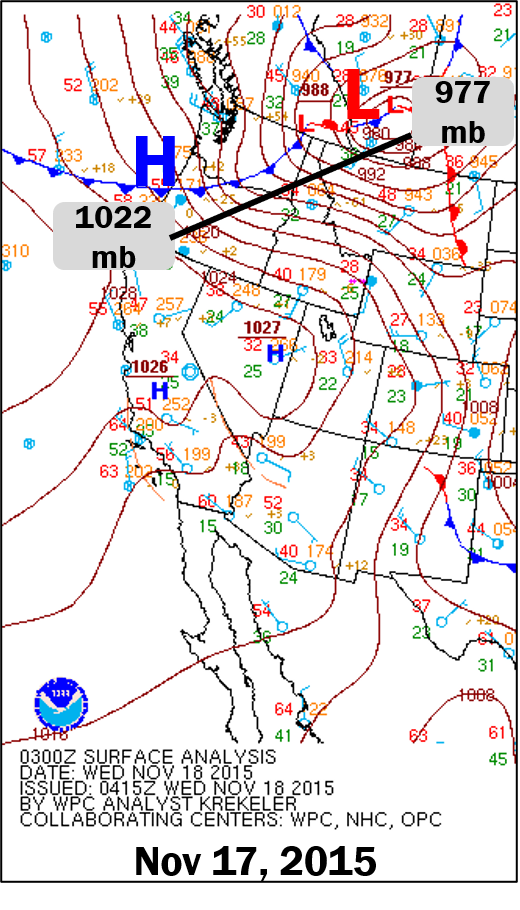
The next most recent high wind event that left quite a bit of damage across our region was Nov 17, 2015. Similarly enough, the max wind gust at Spokane Airport for this event was also 71 mph. Slightly different events that unfolded, but that was the max wind gust. Below is the surface analysis image annotated with the low and high pressures as well. The surface low in southwest Alberta had a low pressure of 977 mb and the surface high in western Oregon had 1022 mb for a surface pressure. This was a difference of 45 mb once again.

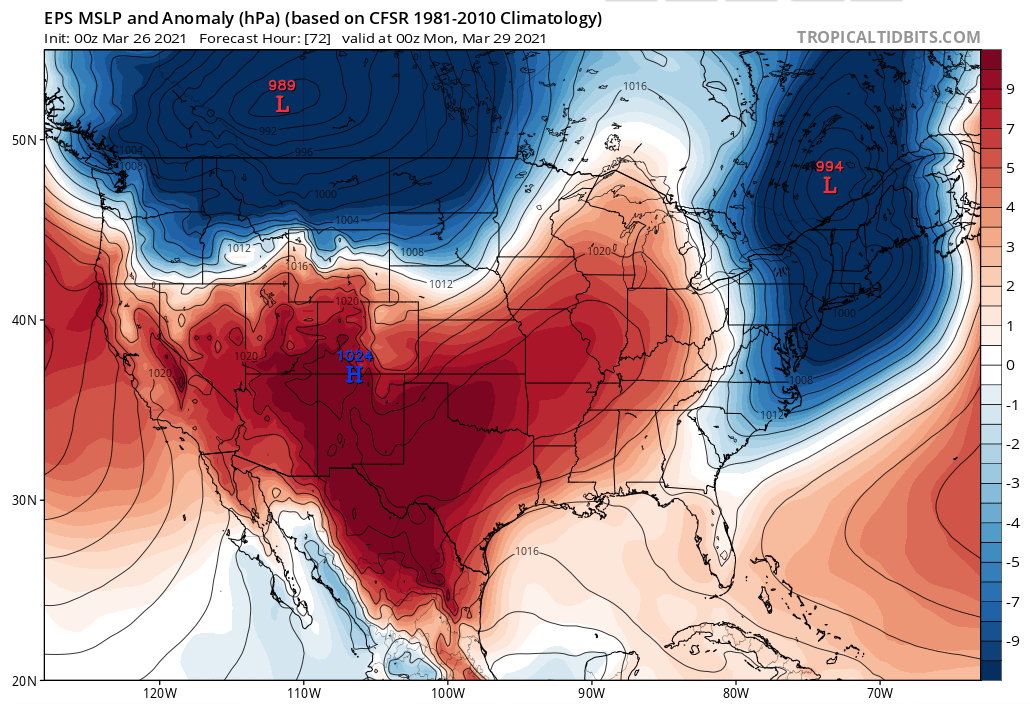
 So now that we are nearing our Sunday night/early Monday wind event, what do the models look like? We’ll look at three different models: European ensemble (EPS), GFS ensemble (GEFS) and Canadian ensemble (GEPS) for comparison sake. First, here’s the European ensemble:


The mean MSLP low is around 989 mb over southwest Alberta and the high is 1024 mb over southwest Oregon, which would give a gradient of 35 mb. Among the various ensemble member forecasts, the surface low has been showing up in relatively the same place, clustering in a way. The clustering shows good agreement among all the different models. This is good! This helps build confidence in the forecast.


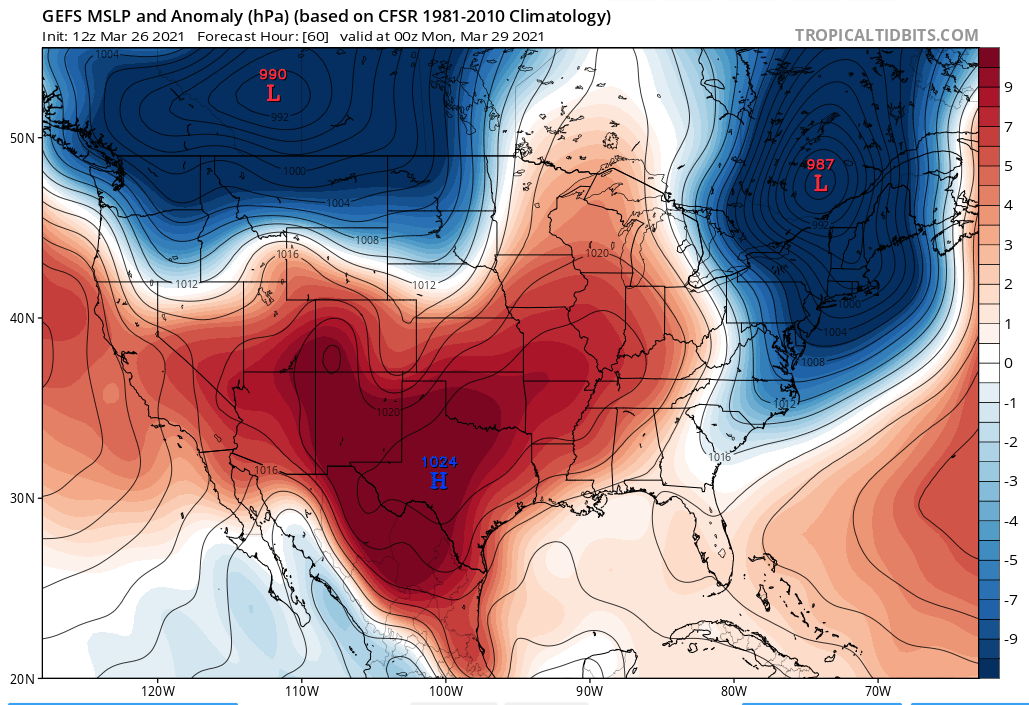
The image below shows the GEFS version of the mean MSLP. The surface low is being positioned in southwest Alberta again. The low is around 990 mb and the high is 1020 mb over southwest Oregon. So our gradient would be 30 mb.


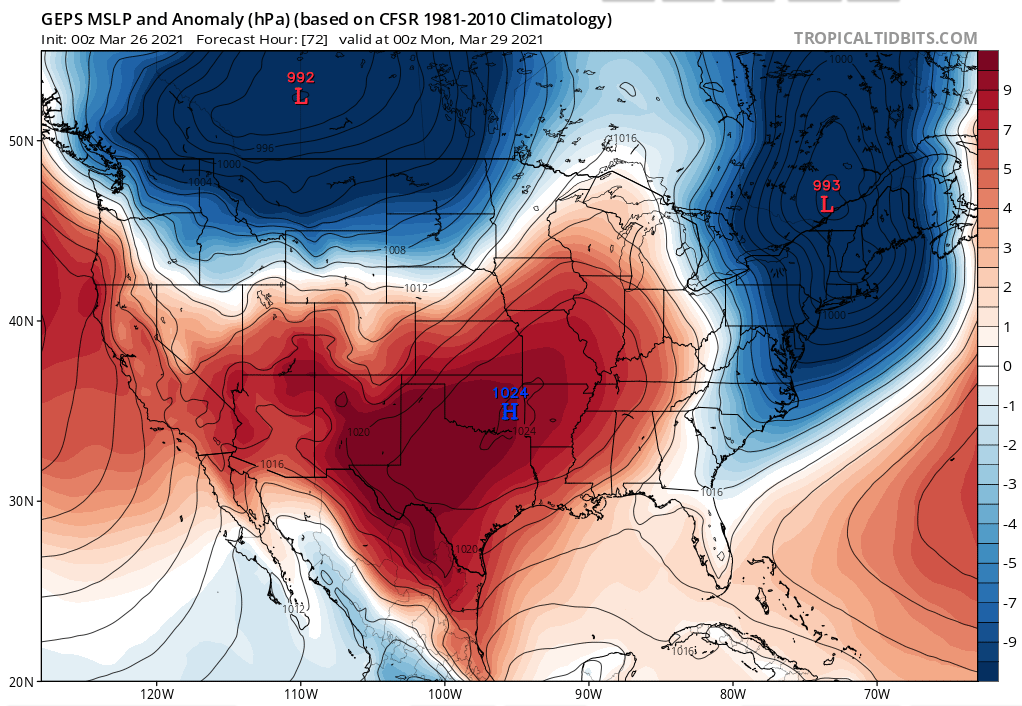
The GEPS version is quite similar to the previous two models. Southwest Alberta low of 992 mb and southwest Oregon high of 1024 mb, which would give a surface gradient of 32 mb. 


Given all of this, what can we say about the upcoming wind event? This wind event does NOT look to be as strong as those from earlier this year and in 2015, at least as of now.


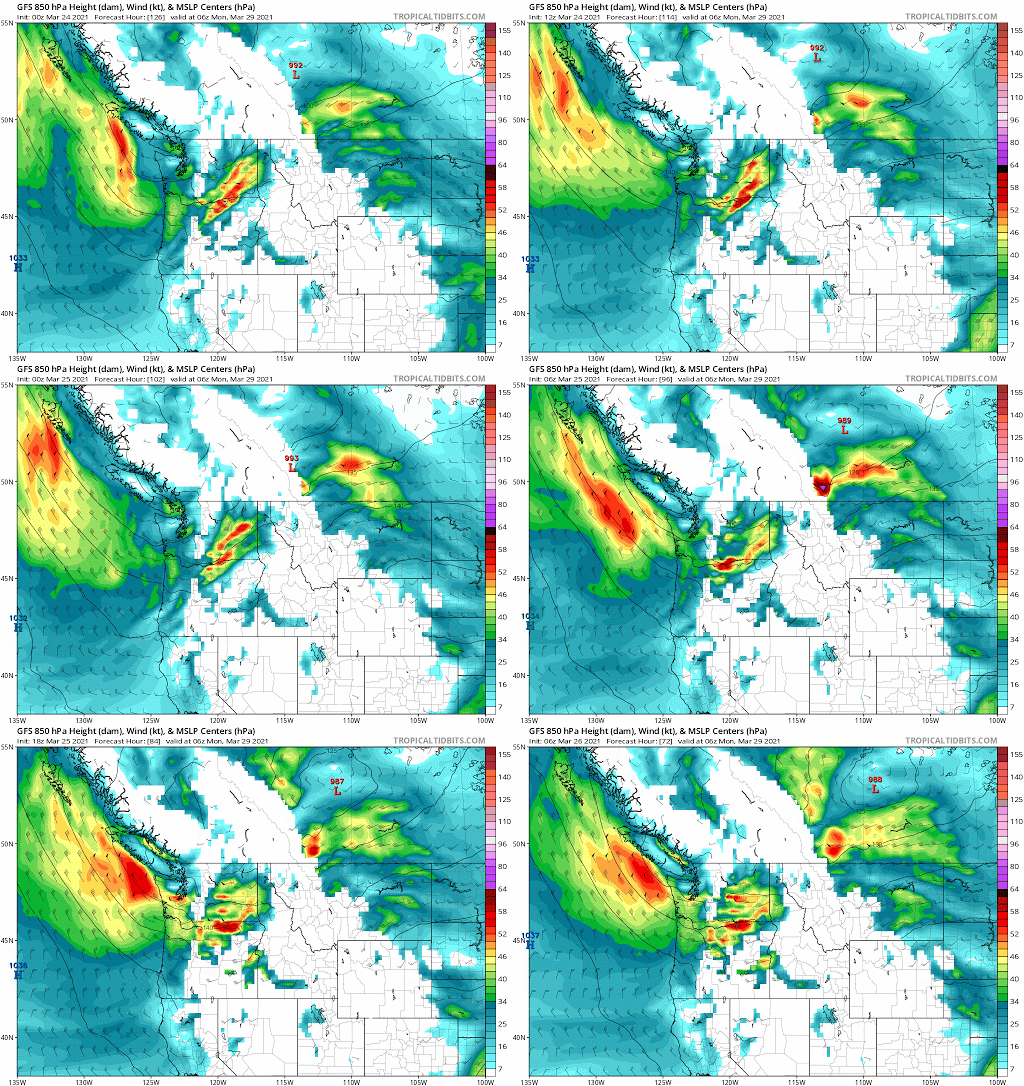
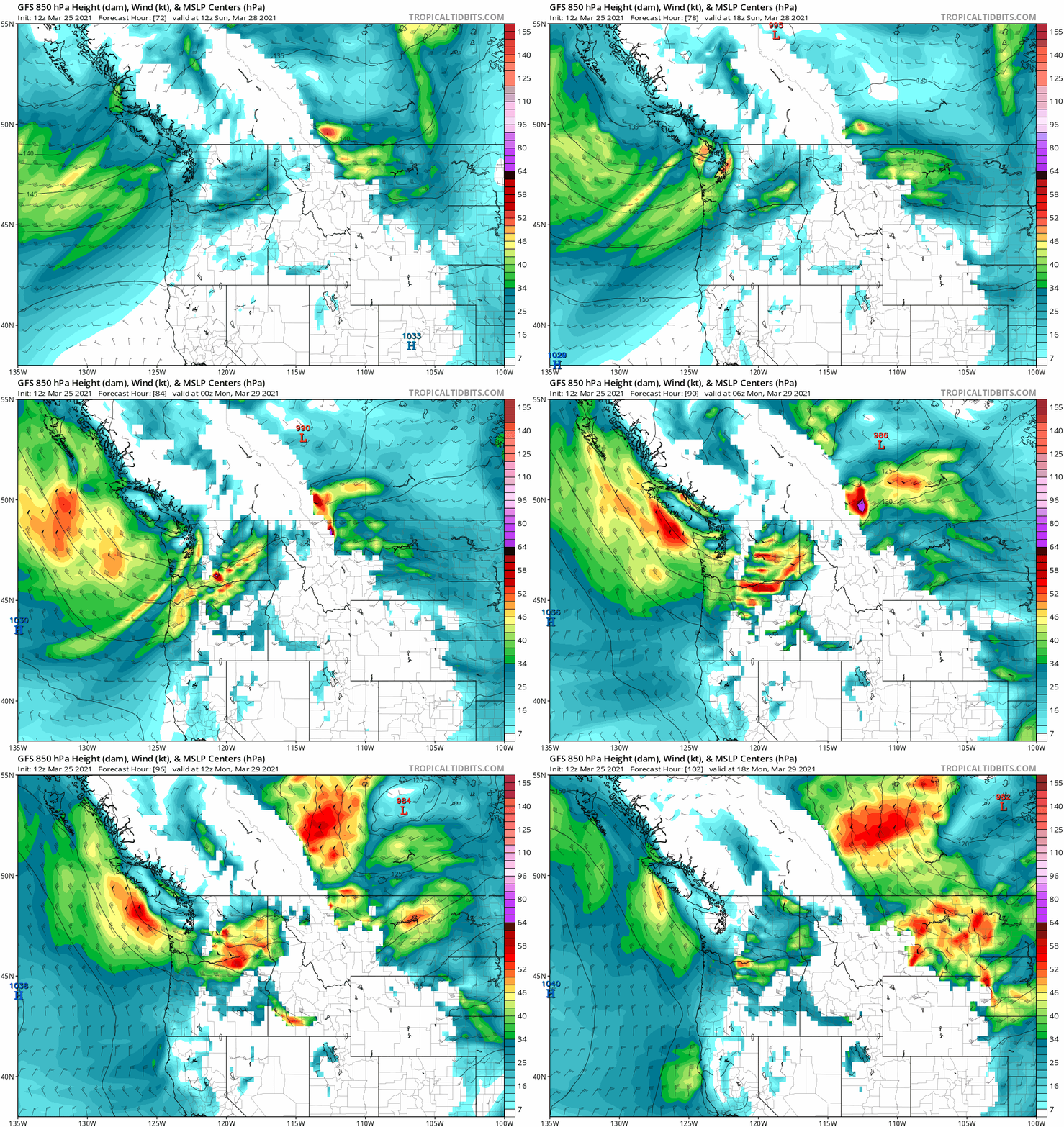
So, we mentioned that we like to look at how the models trend and perform. These are just a select few snapshots of model comparisons. Let’s look at the GFS first. The time stamp we are focusing on is 06z Monday which translates to about 11 pm Sunday night when we will be seeing the peak wind gusts. So as the model has been trending, the winds at 850 mb (which is about 2000-3000 feet above the ground) are showing 45-55 mph across the Columbia Basin and eastern Washington.


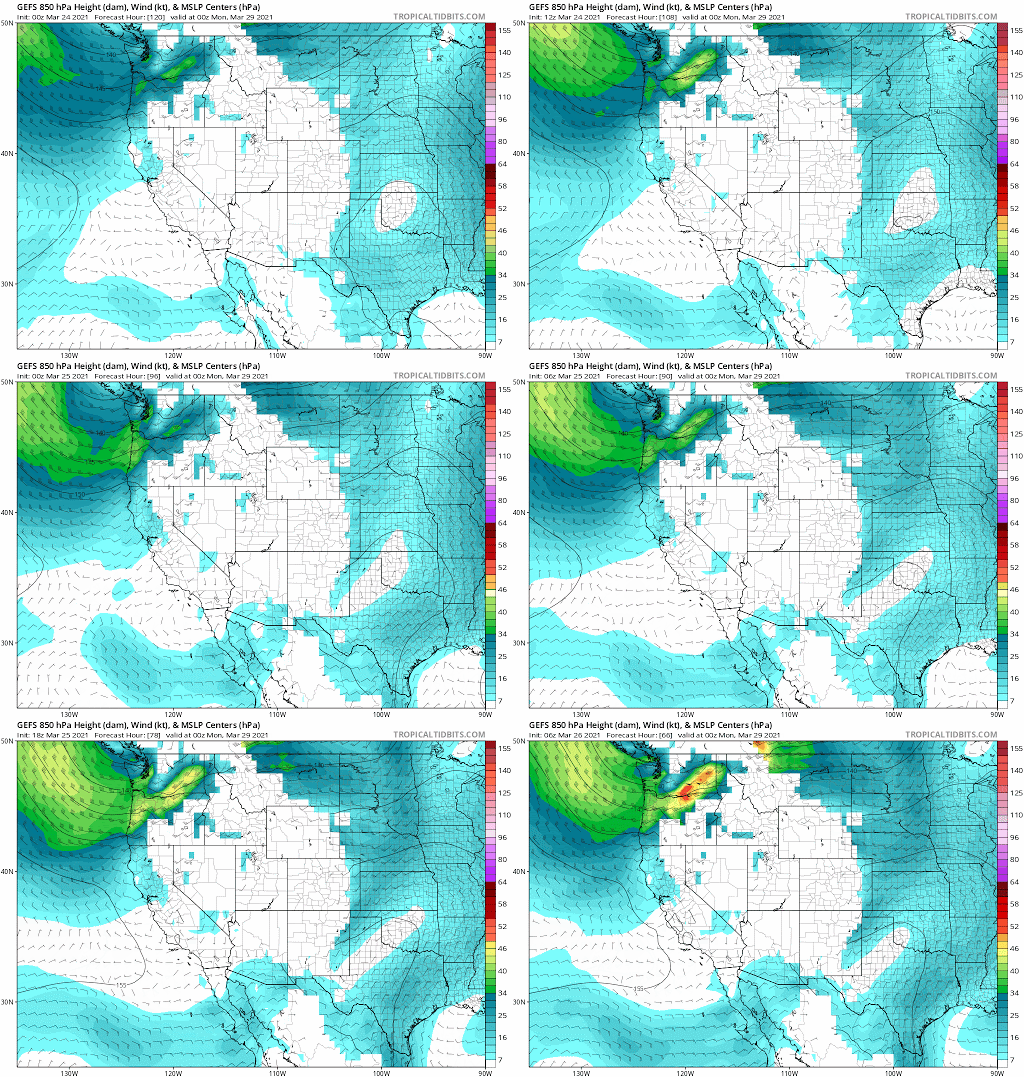
 While a snapshot of a model is helpful, the ensemble version gives us a better idea of more members of said model and how it is all trending. More of a consensus, if you will. Below is a loop of how the GFS ensemble. Showing much of the same as the GFS loop, this is highlighting increasing potential for stronger winds at 850 mb, 45-55 mph and maybe even closer to 60 mph.


That’s a lot of science, so what do I do with that?


You may have asked yourself that, and that is a valid question. As we look at all the model output and try to put together a forecast, we take into consideration what this will mean for folks who live here. What kind of impacts this will create, hazardous weather, and trying to pin down a time is just as important as it is difficult to predict.


Strong winds


Our confidence is growing with each model run that we are analyzing and it looks promising the Columbia Basin and Palouse into the Idaho Panhandle will be the areas that see the strongest wind gusts. Winds will begin increasing through the day Sunday with our cold frontal passage expected during the evening and late night Sunday, giving us the time period of 6 pm - midnight for our strongest winds.


Wind gusts of 45-55 mph looks reasonable with growing potential to see locally higher values in select locations.


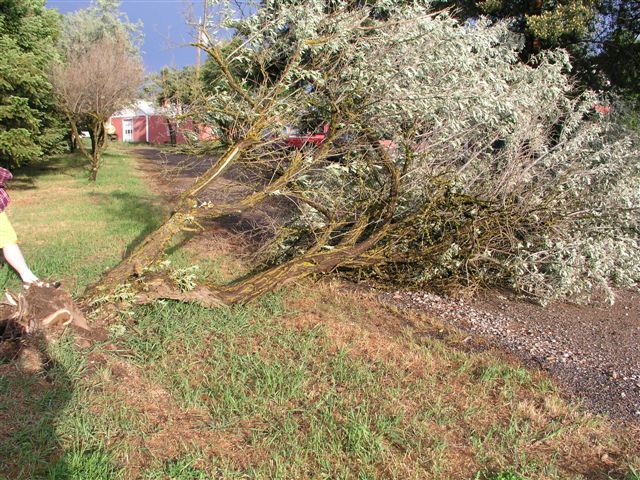
Image showing tree damage from strong winds (not from this event).


Blowing dust


The image above is not a current image but one from a previous event. This is to illustrate the potential for blowing dust Sunday.


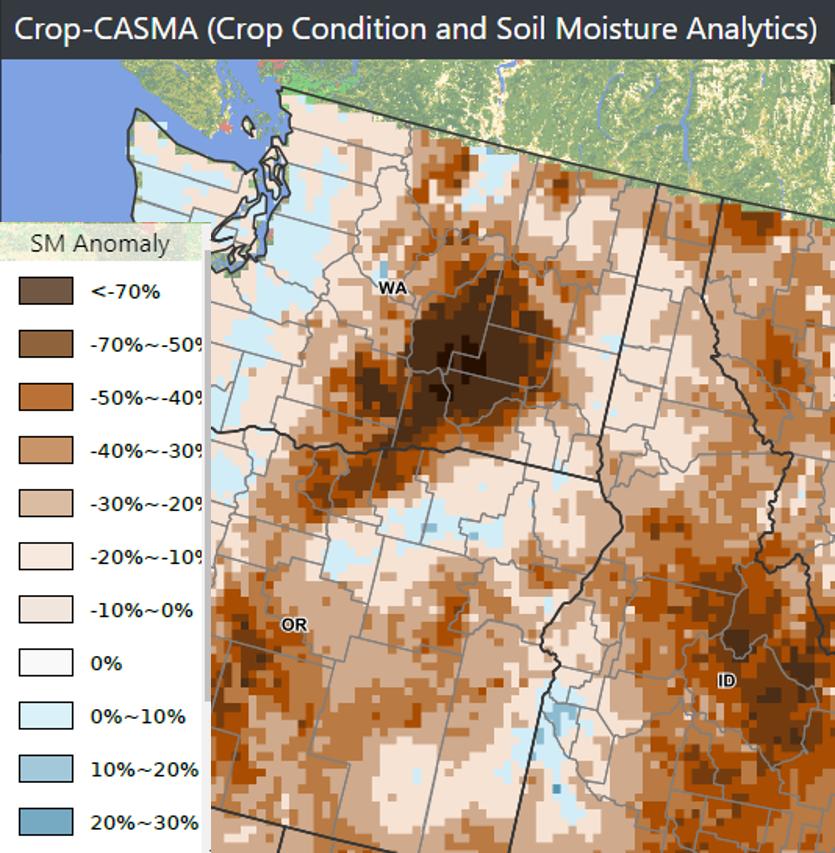
It’s getting to be that time of year when agriculture activity is increasing and fields are being prepped for planting. So much of the central and south-central part of Washington has seen a lack of appreciable precipitation in the last few months, so it is no surprise that this area will be dry and could see blowing dust with these strong winds.  The below image shows crop conditions and soil moisture analysis. It shows just how dry the soils are across south-central Washington.


Stay connected for any forecast updates going through the weekend!


Thursday, March 25, 2021

Wind Storm Late This Weekend Then a Cool Down


Our next weather system to move into the Inland Northwest will come late this weekend. Leading up to that storm system, however, will be more seasonal or warmer than normal weather for this time of year. Let’s look at the details of what to expect going into this weekend.


First, a warm up


Spokane’s normal high and low temperatures are 53°F and 34°F, respectively.

The forecast temperatures for the weekend, Friday, Saturday, and Sunday, are only going to warm each day with Sunday looking to be the warmest of this stretch of days, topping out in the low to mid 60s. 


500mb height chart (above) from the GFS showing the ridge of high pressure building off the northern California coast. This will lead to warmer temperatures through the weekend in the Northwest part of the country.


Then, strong winds


The next cold front arrives late Sunday night with a trough passage. This cold front will move through rather quickly and bring precipitation with it beginning across western Washington earlier on Sunday. By Sunday afternoon, we’ll start seeing rain/snow showers moving up and over the Cascades and beginning to fill in across far eastern, southeastern Washington and northern Idaho. Oftentimes when a weather system is oriented due west, the Cascades tend to “shadow” most of the precipitation from spilling over into eastern Washington. So, most places east of the Cascades may be shadowed for precipitation, except in far eastern Washington along the Idaho border and in north-central Idaho where rain and snow chances are more likely. As for snow for this cold front, the Cascade passes will see moderate to heavy snow Sunday through Monday. What is moderate snow? Well, we're thinking about a foot of snow to some of the Cascade Passes and about 4 - 6 inches in some of the Idaho Panhandle mountains.


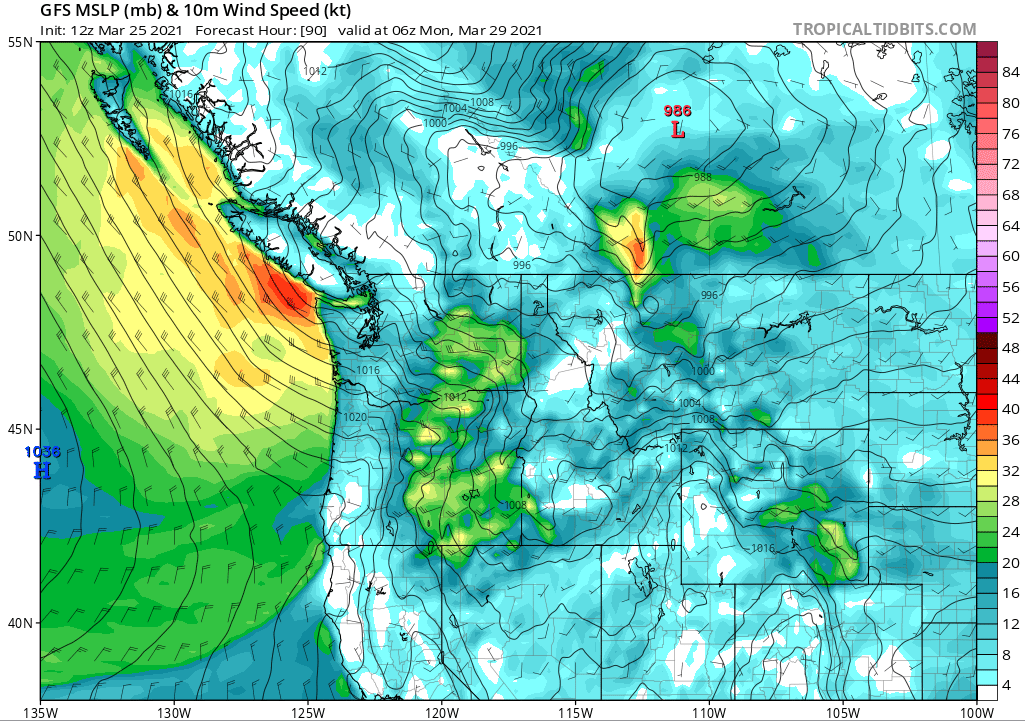
This is the GFS forecast model of wind speed at 850mb with surface pressure centers (notice the red Low moving through Canada).


These are winds at about 4500 MSL which is about 2000-3000 feet above the ground for the Inland Northwest. The loop (above) goes from 5 am Sunday through 11 am Monday. If we take a look at just a snapshot during this time and zoom down to the surface (image below) we see that the surface low pressure begins to intensify over Alberta by late Sunday night and the west-southwest winds across the Columbia Basin and the Palouse begin ramping up (greens and blues = 20-30 mph sustained winds).


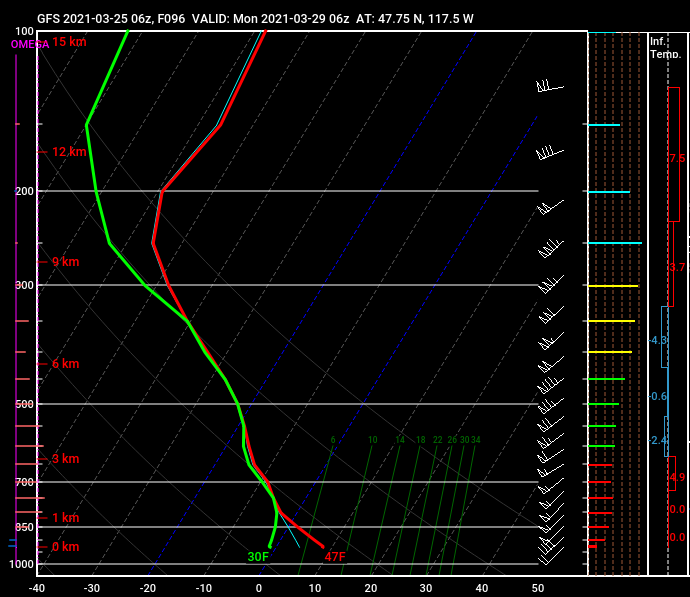
The ability for stronger winds above the surface to mix down to the surface Sunday night into early Monday morning looks decent at several locations across the Columbia Basin. From Moses Lake to Spokane to Coeur d’Alene and into the northern Idaho Panhandle, an unstable layer (better for mixing) rises from the surface to about 3500-4000 feet above the surface. The image below is a forecast sounding for late Sunday night which paints a picture of what the environment might look like. Where the red and green lines meet just above the surface (bottom) is where the environment becomes more stable and therefore not as easily able to mix down those stronger winds. 


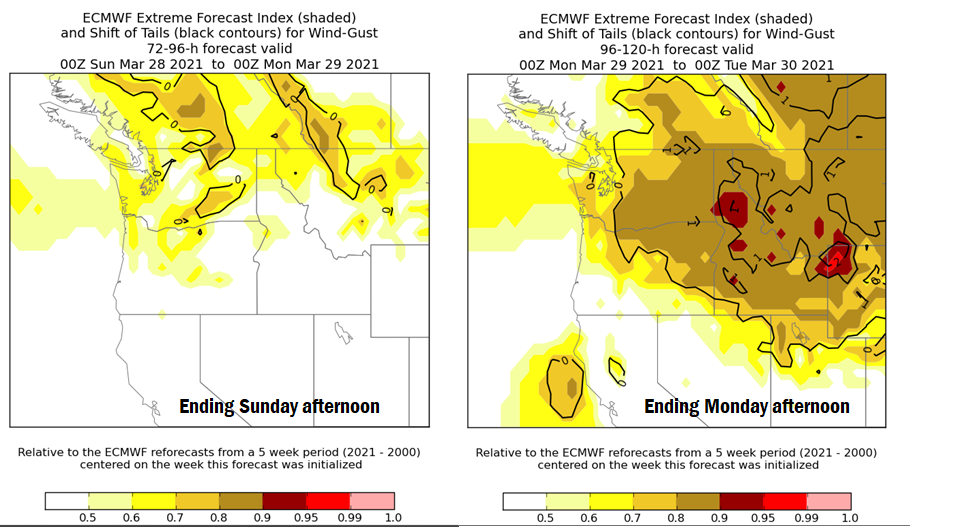
If we look at the European model extreme forecast index for wind gusts for Sunday and Monday we see where the forecast model is hinting at a weather event unfolding that is outside the climatology dataset for a period of time surrounding this date. When we see values greater than 0.8 and even greater than 0.9 we take this to mean a significant event is likely to occur. 


And finally, a sharp cool down


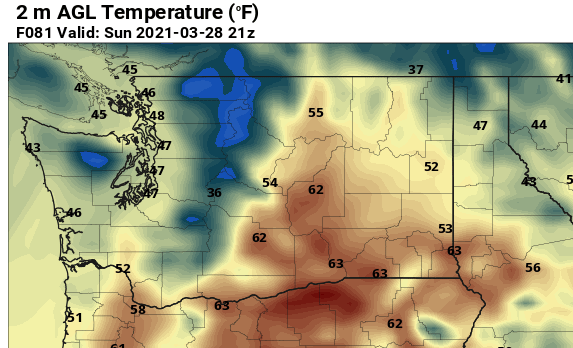
Behind the cold front Monday we will see a pretty sharp drop in temperatures. Sunday we will see daytime high temperatures in the upper 50s and even some low 60s and Monday we may only top out in the mid 40s with overnight lows trending below freezing in the mid to upper 20s through mid-week. Nothing like a potent Spring storm to knock the feel of winter back in briefly! The images below show the daytime high temperature forecast for Sunday afternoon and then Monday afternoon after the front has moved through.


 One model’s depiction of the forecast high temperatures Sunday.

And the forecast high temperatures Monday.


This strong cold front moving through the Inland Northwest this weekend will bring several hazardous weather conditions and associated impacts. A sharp cool down after a few days of warmer than normal temperatures; strong damaging winds possible for a widespread area; blowing dust across some of the drier land areas of agriculture; mountain snow and valley rain although those amounts look to be less impactful in the grand scheme of all of the impacts. Stay connected to the forecast as details evolve!

Sunday, January 10, 2021

Wet and windy storm this week before winter returns next week

For those wondering what happened to La Nina, a more winter like pattern may be returning next week.  So you may want to keep this nearby because it is still winter.  


Later we will discuss what may cause this pattern change and what it could mean.  But before we get to that, we have another storm this week to talk about so let's start with that.

Monday-Wednesday Storm

Another mild and wet storm is on tap for Monday through Wednesday with two surges of moisture as another atmospheric river takes aim at the region.  The first moisture surge arrives from the southwest Monday through Tuesday morning as noted by the influx of moisture from this model run.

UW WRF-GFS Forecast of Integrated Water Vapor Transport valid 4 AM PST Tuesday January 12th, 2021

For most towns precipitation will fall as rain.  One exception is the North Cascades and the Okanogan Highlands especially the Methow Valley where heavy snow is possible.  Also we will be monitoring areas near the Canadian border especially the higher terrain.  Here is the European model extreme forecast index of snow highlighting these areas Monday night into Tuesday.

ECMWF Extreme Snowfall forecast valid 4 PM PST January 11th to 4 PM PST January 12th, 2021


It looks like the moisture feed continues Tuesday night into Wednesday with another significant slug of moisture but with higher snow levels.

UW WRF-GFS Forecast of Integrated Water Vapor Transport valid 4 AM PST Wednesday January 13th, 2021


How much precipitation are we talking?  Rain totals of 0.75" to 1.50" is possible across Eastern Washington and north Idaho with 0.25-0.75" across the Columbia Basin into the Lewiston-Clarkston Valley.  

What about wind?  This is something we will need to keep a close eye on.  Windy conditions are possible Tuesday night into Wednesday across the Columbia Basin, Palouse, and West Plains.  Models haven't been consistent on the wind speeds, but with strong winds above the surface (60-75 MPH at 4500-5000 feet MSL) we will be monitoring the potential for some of this to mix down to the surface.  Here is one model depiction of those winds.

Jan 10th 18z GFS run of 850mb wind speeds (shaded) and heights.  

Return to winter next week

January has been off to a mild start.  But we are looking at likely changes next week.  Here is a look at the first nine days of January highlighting the mild start.

Climate Toolbox image showing average temperature anomaly January 1st-8th, 2021


And the mild temperatures will continue this week.  The Tuesday and Wednesday system will have plenty of mild air associated with it.  Here is an animation from an ensemble system that shows the mild pattern dominating this week, but look at those cooler temperatures over western North America during the Jan 21-26th time frame!

12z/Jan 10th GEFS 2 meter temperature anomaly (degrees C) valid Jan 11th-26th, 2021


What could cause such a change?  

12z/Jan 10th GEFS 500mb height and anomaly (shaded) valid Jan 11th-26th, 2021

Note the big pattern change that occurs during the period.  We start off with low pressure in the Gulf of Alaska with a prevailing southwest flow bringing in the mild temperatures.  But during the Jan 21-26th period there is a noteworthy shift in the pattern, with high pressure building in the eastern Pacific bringing a cooler north to northwest flow to the area.  

Now this is just one modeling system, but other models run out of Canada and Europe show a similar change, and this change has been indicated by these models over the past several days which does yield more confidence in the change.

What will this mean?  Looks like a good bet for more winter like temperatures.  And potentially some precipitation to go with it likely in the form of snow.  Stay tuned for updates as we get closer.


Wednesday, December 16, 2020

Weekend Storm

This weekend we are monitoring the potential for weather impacts across the region as an Atmospheric River takes aim at the area.   While the weather will differ depending on your location, there are several items we are monitoring including moderate to heavy rain, some mountain snow, wintry mix potential for the Methow Valley, and windy conditions.

Here is one model depiction of an Atmospheric River aimed at the region Saturday night.


00Z Dec 16th GEFS forecast of Integrated WVT valid 10 PM PST Dec 19th, 2020

But you may be asking, what is an Atmospheric River?  Basically it is a column of very moist air containing high amounts of water vapor that gets transported towards the west coast by moderate to strong winds.   The graphic below contains lots of information, but worth a read for those wanting to know more, with this link also providing more information.


So what kind of impacts will this lead to this weekend?  First let's begin with the warmer temperatures.  

WARMER TEMPERATURES

Some of the raw model data suggests Spokane could reach 50 degrees as noted by the big upward spike in temperatures Saturday night into Sunday

Various model forecasts of surface temperatures for Spokane Airport through Dec 20th, 2020

The Tri-Cities area could reach 60 degrees.
Various model forecasts of surface temperatures for Pasco through Dec 20th, 2020

And the warmup isn't just for Spokane.  This model depiction during the peak of the warmer air shows freezing levels possibly reaching 6000-9000 feet MSL.

12z Dec 16th UW WRF-GFS forecast of freezing level (MSL) valid 4 AM PST Dec 20th


WINDY CONDITIONS

In addition to the warmer temperatures, models show an area of enhanced winds across the Columbia Basin, Palouse, and up into the Spokane area. 
12z Dec 16th GFS model forecast of 850mb winds (shaded) and heights valid 4 AM PST Dec 20th

These are winds at about 4500 feet MSL, which is about 2000-3000 feet above ground level.  For those looking closely at the legend, those red colors correspond to 50-65 kt (55-70 MPH) winds!   Winds at this level can represent wind gust potential but it all comes down to mixing of the lower atmosphere as to wind gusts that are experienced at the surface.  Typically in these more stable atmosphere regimes the higher gusts don't reach the surface with model guidance suggesting wind gusts of 40-55 MPH being a more probable outcome, but something we will continue to monitor.

PRECIPITATION

What about precipitation?  Here is one model depiction starting 4 PM Saturday.

12z Dec 16th GFS 6 hour precipitation rate and precip type valid 4 PM PST Dec 19th

It looks like precipitation type is mainly rain with mountain snow up near the Canadian border.  Some model output suggest some of the mountain passes may start off as snow with possible accumulations.  Also note the pink area in the above graphic around the Methow Valley where cold air often has a harder time scrubbing out.  This denotes a potential wintry mix.

Fast forward now to 4 AM Sunday.
12z Dec 16th GFS 6 hour precipitation rate and precip type valid 4 AM PST Dec 20th

As warmer air surges north, rain is the main precipitation type even up to the Canadian border, with rain intensity increasing in the Cascades as noted by the orange and red colors.  What is interesting though is the lack of significant precipitation in Central and Eastern Washington.  While these Atmospheric Rivers have an abundance of moisture, the strong winds often "ring out" much of the precipitation over the Cascades, with downslope flow off the Cascades leading to a drier conditions in Eastern Washington and especially Central Washington.  Here is one model depiction of 24 hour precipitation highlighting this

12z Dec 19th GFS forecast of 24 hour precipitation ending 10 AM PST Sunday, Dec 20th

SNOW MELT AND HYDROLOGY OUTLOOK

Here is the latest snow analysis as of this morning, Dec 16th.

Modeled Snow Water Equivalent (SWE) valid 8 AM PST December 16th, 2020

The warmer temperatures and breezy to windy weather this weekend will melt much of the lower level snow pack leading to rises on small streams.  Thankfully the incoming Atmospheric River will be of shorter duration (24-36 hours) over our region.  This combined with the lower stream flows to start should keep the flooding threat low.  Although the best combination of warmer temperatures, snow melt will be over the Palouse area so will be monitoring Paradise Creek.  The Cascades will see a burst of heavy precipitation, but the deep snow pack may absorb much of the rain for the East Slopes of the Cascades.  But in Western Washington, some rivers may reach flood stage based on forecasts as of this morning.

River Forecast Center Max Flood forecast page.  See link below for latest forecasts

For the latest river forecasts, click here

In summary, expect an active weekend with a wide variety of expected weather.  Stay informed of latest forecasts.  And for those wondering about having a White Christmas, not much has changed with our thinking since the last blog post through the 20th, which can be found here.  There is low confidence with the Dec 21nd-22nd forecast as models are not in good agreement with a possible weather system during this period.  Yet another opportunity for precipitation may arrive on Christmas Eve or Christmas Day so stay tuned for updates.


Monday, December 14, 2020

White Christmas this year?

Many of you may be wondering about odds of a White Christmas this year.  Snow has covered the ground recently in many areas, but will it stick around until Christmas?  What about the outlook for Christmas Day?

First let's start with the climatological odds of a White Christmas.  As always, the odds depend on where you live as the map below shows

Odds of a White Christmas, defined as 1" of snow or more on the ground, based on historical data shows the odds increase as you travel northward in the Columbia Basin up into the Spokane/Coeur d'Alene area.  And along the East Slopes of the Cascades, northern mountains, and Idaho Panhandle mountains the odds are very high (>90%).  There is a great article explaining this map here that has more background information, including an interactive map.

You may be saying ok these are the historic odds, but what about this year?  Let's start with where we have snow.  The map below from December 13th shows water content in the snow, which isn't much where most people live.  

Modeled Snow Water Equivalent (SWE) valid 4 AM PST Dec 13th, 2020


And the latest CoCoRaHS map from today (Dec 14th) shows many of these locations only have between 1-4" of snow on the ground, except for higher amounts around Republic and the upper Methow Valley.

CoCoRaHS map of Max Observed Snow Depth Dec 13-14th, 2020

For an interactive version of this map, click here

Why all this talk about what is on the ground now?  Because many areas may have a hard time keeping it.  More on that in a minute.  First it is worth mentioning that some areas will get more snow this week.   But snow levels will be gradually increasing.  The latest forecast for your location can be found at weather.gov/spokane

Temperatures are forecast to warm up this week, especially over the weekend.  This may melt much of the snow over the region.


Here are the forecast temperatures this week for Spokane, Omak, Lewiston, and Wenatchee.

NWS Forecast Temperatures issued 3 AM PST Dec 14th, 2020

Why the big warmup this weekend?  A mild Pacific jet stream aimed at the region

12z/Dec 14th GEFS forecast of 250mb winds (shaded), and MSLP valid 4 AM PST Dec 20th, 2020


And this particular model solution depicts warm southwest winds across much of the area.

12z/Dec 14th GFS forecast of 850mb winds (shaded) and heights valid 4 AM PDT Dec 20th, 2020


Mild temperatures and wind can melt snow very quickly.  Thus, there is a good chance of a complete snow melt off across the Columbia Basin, Spokane/Coeur d'Alene area, southward through the Palouse if these model solutions verify.  Tougher call for the northern valleys.  The Cascade valleys should have enough of an established snowpack to keep snow on the ground.

This takes us through December 20th.  So for areas that lose all their snow this weekend, will the snow return in time for Christmas?  This is getting far out into the forecast, but there has been some hint of a potential system with lower snow levels Dec 21-22nd.

12z/Dec 14th GEFS forecast of 500mb heights and anomaly valid 10 PM PST Dec 21th, 2020

Confidence isn't high, but some areas could get some snow out of it.  After that there are signs of high pressure trying to build over the region in time for Christmas.  But it's not very strong which could open the door to some weaker systems.  Of course this is more than a week out so confidence in the details is low.

12z/Dec 14th GEFS forecast of 500mb heights and anomaly valid 4 AM PST Dec 25th, 2020


In conclusion, a white Christmas defined at 1" or more of snow on the ground is a good bet for the Cascade valleys, and possible for the northern valleys into the Idaho Panhandle.  From the Wenatchee area through the Columbia Basin, Spokane/Coeur d'Alene area, Palouse, and Lewiston-Clarkston Valley a White Christmas is possible if new snow coats the landscape after the weekend warm up.