Sunday, April 23, 2023

Significant Warming This Week

***Updated Apr 24th with new forecast numbers*** 

Are you ready for warmer temperatures?  A big change in the weather pattern is coming, bringing the warmest temperatures of 2023 so far for many locations.  First lets take a quick peak of what has been going on this spring, and why it has been so cold.

Most days this spring have brought below normal temperatures. Below is a plot of temperatures in Spokane and Wenatchee since March 1st.  The blue bars are observed values, with the brown shaded area normal values.  As you can see, most days have been cooler than normal, with observed temperatures the past 30 days showing little in the way of warming despite the normal temperatures increasing.

Spokane (GEG) temperatures since March 1st.  Blue bars are observed.  Brown shading is the normal range.  Top red line is record high values, while bottom blue line is record low values.

Wenatchee (EAT) temperatures since March 1st.  Blue bars are observed.  Brown shading is the normal range.  Top red line is record high values, while bottom blue line is record low values.

Why has it been so cold? There has been a persistent trough over the region as noted by the dark purple shading on the map below over the Pacific Northwest.

500mb temperature anomaly March 1st-April 19th, 2023

Significant changes are in the forecast.  Here is a loop showing the weather pattern this week, with strong high pressure forecast to build over the western US, which will bring the warmest temperatures of 2023 so far.

Forecast weather pattern this week - showing 500 mb heights and anomaly through April 30th, 2023

How confident are we in the warming trend?  For this answer our forecasters like to look at what are called "Box and Whisker Plots".  This sophisticated method takes in what are called ensemble forecasts.  Approximately 100 forecasts from various model ensemble forecasts compose these forecasts, giving forecasters an idea of the range in possible outcomes.  Small boxes means generally higher confidence in the forecast due to a smaller range in values, while a wider range means less confidence.  So what are the models showing for forecast temperatures this week for Spokane?

***Updated Apr 24th*** GFS, ECMWF, and Canadian Models Box and Whisker Forecast for temperatures for Spokane, WA through May 2nd, 2023

The red boxes represent the high temperature forecast, with the boxes staying fairly small through Saturday, with high temperatures warming into the 70s.  By next Sunday and especially Monday the boxes increase in size, leading to more possible outcomes and thus less confidence. You may be wondering what the vertical gray lines mean.  These are the "whiskers" and represent the model solutions that are more extreme (both warm and cold) but are still important information for forecasters to consider.

But we have taken things even a step further.  All the temperature forecast above are straight from the models, and have not gone through any sort of calibration.  Why is this important?  It's possible a model can have a persistent bias towards being too warm or too cold, which is important to try and alleviate.  This is where the NWS relatively new set of forecasts come into play.  Below is the calibrated version from the NWS NBM (National Blend of Models).

***Updated Apr 24th*** National Blend of Models (NBM) Box and Whisker Forecast for temperatures for Spokane, WA through May 3rd, 2023

This pretty much says the same story, just with slightly different numbers and ranges.  Increased box size later in the weekend into early next week means there is increased uncertainty out that far into the forecast.

Some may be saying "This is too complex, just tell me what the temperatures are going to be!"  Well we can do that, but it's always good to have some background information into the forecast so you know how confident we are.  Here is our forecast as of Sunday morning for the upcoming week.


***Updated*** NWS Official Forecast Temperatures issued 3 AM PDT Monday, April 24th, 2023

The warmest temperatures of 2023 for many locations are forecast this week.  How long will it last?  This is unknown with a lot of model variability heading into next week.  For the latest forecast, head to https://www.weather.gov/spokane

Saturday, April 8, 2023

Heavy precipitation expected, but will we see flooding?

Warm and wet weather is coming to the Inland Northwest. But how wet is it going to be and will the resultant precipitation result in widespread flooding? This can be answered by looking at a few things, including precipitation amounts, snow melt, and antecedent conditions. We will start by discussing the precipitation. 

PRECIPITATION: The latest official forecast for Spokane is calling for 0.97" of rain over 48 hours starting 11 AM Sunday and lasting through 11 AM Tuesday. Spokane won't be the only area receiving significant rainfall, but much of the Inland Northwest will as well. This rainfall is coming from an unusually strong atmospheric river for this time of year. In fact, we could set a daily record for precipitable water values (total amount of moisture in the atmosphere) on Monday. 


Atmospheric River forecast

This event places just below the top 10 wettest (12th wettest) 48 hour stretches for Spokane (records back to 1881) in April. If 1.00" of precipitation were to occur this from Sunday morning through Tuesday morning in Spokane, the monthly total precipitation so far (1.33") would exceed the average April total (1.12") within the first 11 days. That would place the April 2023 total precipitation in the top 33% of all years by the 11th. It would also be the wettest 48 hour period the Spokane area has seen since May 20, 2020. 
Probabilistic data from our weather models are useful to predict the chance of 1.00" of rain over 48 hours in Spokane early this week. The current odds of exceeding this total in 48 hours is 16% so we are forecasting on the wetter end compared to the weather models. 12 hours ago, the weather models were indicating only an 8% chance so the newer runs of the weather models have doubled the odds of greater than 1 inch or rain.


Another way that we communicate forecast uncertainty is through using a range of possibilities such as a low end amount (90% chance that there will be more rain than what is forecasted) or a high end amount (10% chance of there will be more rain than what is forecasted). The first graphic below represents the low end amount for Spokane with this event. The second graphic represents the high end amount for Spokane. Given our official forecast is calling for 0.97 inches of rain, we are forecasting on the wetter side of the model possibilities. To follow the latest official forecast, please visit www.weather.gov/spokane.
Low End Amount (90% chance of exceeding 0.3" of rain)

High End Amount (10% chance of exceeding 1.13" of rain)

SNOWMELT: The other piece of the puzzle is what what will happen to the existing snowpack? Will we melt a considerable amount of it, adding to the precipitation runoff, or will it stick around for a while? Although this might sound like an easy question the answer, it is more nuanced than you might think. Even if the temperatures get well above freezing, that doesn't necessarily mean the snow will instantly melt and runoff into the rivers. First off we need to warm the snowpack temperatures to freezing. This animation below shows the snow pack temperatures over the past week. Red colors show the snowpack temperatures around freezing and primed for melting. Notice the rapid expansion of the red over the past week over the northern third of eastern Washington, especially in the valleys below 3000-3500'.   


This suggests the snow will melt off quickly in the northern valleys especially considering we are going to see temperatures well above freezing from tonight through Tuesday night. However, even the snow is going to melt, that doesn't necessarily translate to it running off since it can be soaked up by the existing snowpack. How can we determine if that's going to happen? To determine if the snowmelt is going to runoff we utilize something called snow density which is the ratio of the snow depth to the amount of water in the snowpack or snow water equivalent. For snowmelt to effectively runoff we want to see snow densities of  50% or greater. 

If you look closely at this map below most of the values are well below 50%. But the problem with this map is most if not all the values in the Inland Northwest are in the mountains above 3500' and don't tell us about the density of the lower elevation snow however we can be certain the snow ratios are higher than what's seen on this map. Consequently we'd expect to see a good amount of the low level snow melting off into the nearby rivers over northeast and north-central Washington and north Idaho.  But will that necessarily lead to flooding? 

Snow density values as of 4/8/2023


ANTECEDENT CONDITIONS: To help answer if we expect to see flooding, we can look at the antecedent conditions, or in other terms what's going on with the current river levels or soil moisture. Much of that can be determined by how much precipitation we've seen recently combined with how much snow melt we've seen. Over the past 3 months it has been exceedingly dry over the Inland Northwest, especially over north Idaho and extreme eastern Washington where some precipitation amounts are around half of normal. 

90 day percent of normal precipitation

Despite the dearth of precipitation, the much cooler than normal weather has resulted in a relatively normal snow water equivalent for this time of year. But it's a far cry from what most of the Western US has experienced this winter (widespread dark blue)

Snow Water Equivalent for 4/8/2023

So what do you get when you have lighter than normal precipitation and a relatively normal snowpack? This means there hasn't been a significant amount of runoff into the rivers. So how light has the runoff been this Spring? Extremely light is the answer! Check out this map below for the specifics. 

Steamflow vs normal for 4/8/2023

Notice all the red dots clustered over north Idaho into portions of northeast and north-central Washington. The dark red dots show locations that are much below normal for this time of year (10th percentile), and the bright red dots correspond to locations that are at their lowest level for the current date. These record and near record low spots include much of the Coeur d'Alene, St. Joe and Pend Oreille Basin in north Idaho and the Spokane (hidden by green dot over Hangman Creek), Okanogan, and Kettle River Basins in eastern Washington. 
For the Coeur d'Alene River, near Cataldo, it is at its lowest level for the date in the past 88 years! 

If we want to examine current ground water conditions, across the Columbia Basin there is a well sensor located just southwest of Davenport. Long term drought conditions have resulted in a steady drop in the water table since 2017. In fact at the beginning of the year the water table was roughly 50' below ground and the lowest this well has seen since 1992. 
Well Water Table southwest of Davenport, WA


THE FINAL VERDICT: So adding all this information up, what does this tell us? It tells us we have a lot of room in the rivers and groundwater to accommodate this upcoming rain and snow melt event.  So at this point we expect this to be a largely beneficial event rather than one with destructive flooding. That's not to say there won't be any minor ponding of water in low-lying areas, but we don't expect to see any major flooding at this time. Stay tuned for updates and monitor our latest forecasts for details. 

Wednesday, March 1, 2023

Inland Northwest, has The Winter of 2022-23 Been a Harsh One?

February has come to an end. Do you feel like this has been a bad winter?

Some may say, “Yes! This has been a long and harsh winter.” Others may have the opinion, “No. This winter seems pretty typical to me.” Let’s take a look at some data.
  1. Total snow accumulation
  2. How long snow has been on the ground
  3. Average temperature
  4. Extremely cold temperatures
  5. Winter’s duration

Our first data set

Total snow accumulation:
Has this winter been snowier than normal? Let’s look at a handful of snowfall graphs and compare them to the 30 year average (1991 - 2020).

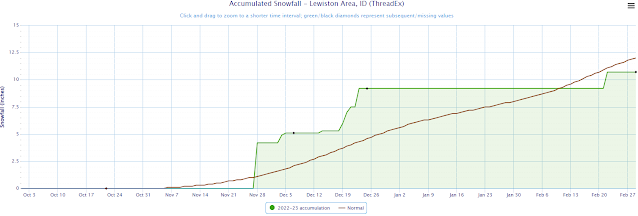
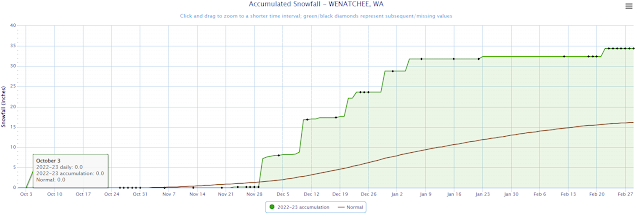
Accumulated Snowfall Graphs: 1) Spokane 2) Bonners Ferry 3) Lewiston 4) Wenatchee These graphs compare the snow that has fallen this winter (green trace) with the 30 year average (smooth brown curve).

SpokaneBonners Ferry ID
Lewiston ID
Wenatchee WA
graphs generated by xmACIS2

There are similarities between the first three graphs from Spokane, Bonners Ferry, and Lewiston. By February 28th, each trace is within a few inches of the seasonal average. The trace from Wenatchee is much different with nearly double the average snowfall through Feb 28th.

What about snow in the mountains? Snow sensors called SNOTEL (SNOpack TELemetry) collect data from remote high elevation locations across the Western U.S. and Canada. So this map will tell you more about mountain snow than the snow that has fallen in cities and valleys. The graphic below shows the Snow Water Equivalent (SWE) values for river basins across the Pacific Northwest as of March 1st. While many basins in Washington and north Idaho range from 85 to 100 percent of average, north central Washington stands out. Values in the mountains around Omak and Republic are as high as 130 percent of average.

Basin Snow Water Equivalent compared to normal.


Verdict based on total snow: Residents of north central Washington and Wenatchee are probably justified in calling this a harsh winter if we look at total accumulated snow for the season. For the rest of us that have had close to average snowfall, we may need to find another argument.

Our second data set

How long has snow been on the ground? Have you ever heard someone say something like this, “I remember that terrible winter! We had snow on the ground from Thanksgiving to the beginning of March!”

Finding data for how long snow has been on the ground is tough. There are only a handful of sites in the Inland Northwest that take daily snow depth measurements, and periods of missing data over the years makes it difficult to build a climatology of snow depth data. But, here’s a crude table from a few of our dedicated cooperative observers that provide the NWS with daily snow depth measurements.

Consecutive Days with Snow Depth of at Least 1 Inch

Site

First Day

Last Day

Total Days

Max Depth

Bonners Ferry ID

Nov 23

Jan 31

70 days

20” (Dec 21)

Moscow ID

Nov 28

Jan 3

37 days

14” (Dec 23)

Northport WA

Nov 23

Jan 19

58 days

16” (Dec 21)

Spokane NWS

Nov 7

Feb 7

93 days

16” (Dec 20)

Spokane Airport

Nov 7

Jan 15

71 days

15” (Dec 21)


With 93 consecutive days of at least 1 inch of snow on the ground, employees of the National Weather Service have seen a lot of white on the landscape this season. Folks around Bonners Ferry are used to seeing snow on the ground for weeks during the winter, but 70 days is a long time to deal with snow on the ground, too.

Verdict based on how long snow has been on the ground: Inconsistencies in the data make this a tough argument. There is also a lot of variability in the typical snowpack across the Inland Northwest depending on elevation and local snow climatology. However, many places in the Inland Northwest received snow in November. For those of us who held onto that snow well into February, you are probably justified in saying that you have seen snow on the ground for a long time this winter

Our third data set

Temperatures compared to average: For the Pacific Northwest winter-like temperatures arrived early. November was a particularly cold month. For the state of Washington, November ranked as the 6th coldest on record according to the National Centers for Environmental Prediction. Idaho experienced its 4th coldest November on record!

https://www.ncei.noaa.gov/


December remained cold especially in Washington, ranking 17th coldest on record. The state average temperature for Idaho didn’t rank as cold. Idaho had its 48th coldest December on record.


January trended toward milder temperatures. States in the Pacific Northwest were actually “Near Average” or slightly “Above Average”.


As of the creation of this blog, statewide average temperature ranks have not been calculated for February. However, data collected by the Western Region Climate Center indicate that February will end up with below average temperatures.


Verdict based on temperatures compared to average: Even though January was not particularly cold, November, December, and February were colder than average. And since November’s temperatures were so much below average, it seemed like the Pacific Northwest got an “extra December” this winter. Residents of the Pacific Northwest are justified in saying that this winter has been a long one. And the arrival of an Arctic blast late in February makes this winter seem even longer for many Washington and Idaho residents.


Our fourth data set

Extremely Cold Temperatures: Speaking of Arctic blasts, how many of them did the Inland Northwest experience this winter? There have been five identifiable Arctic fronts this winter. Beginning with our first Arctic front in early November and including our late February blast of cold temperatures, the Inland Northwest has experienced biting north winds and dramatic temperature drops about every 3 or 4 weeks this winter.


Our most noteworthy Arctic front of the season occurred between December 21st and 23rd. Widespread below zero readings were observed with some of the coldest locations dropping below -20F, including Porthill (-30F), Addy (-28F), Naples ID (-27F), Colville (-24F) and Bonners Ferry (-20F). Some of these readings were the coldest in decades. Northeast and north central Washington experienced lows of -20 to -30 degrees! Temperatures in our region hadn’t been that cold in a decade or two.


Morning temperatures December 22, 2022


Our most recent Arctic front broke or tied several records for February 23rd and 24th. Spokane’s low temperature of 3 degrees on the 24th tied the record set in 2011. Several stations including Spokane, Wenatchee, Ephrata, and Omak experienced record cold afternoon high temperatures on the afternoon of February 23rd when highs struggled to reach the mid teens and low 20s.


Verdict based on extreme temperatures: While there have been relatively few record cold temperatures this winter, residents of the Inland Northwest are justified in claiming that this winter has featured some of the coldest temperatures in many years. The December 21st to 23rd event was really cold for our region!

Our fifth data set

Winter’s Duration: We have already mentioned that winter “arrived early”. November was much colder than average, and many places across the Inland Northwest were snowier than average in November, too. Will winter also be late to loosen its grip on the region?

The latest outlook from the Climate Prediction Center for the month of March does not look favorable for an early arrival of spring. There is a 60 to 70 percent chance of colder than average temperatures for the month of March. Snow in March typically struggles to accumulate and frequently doesn’t last long. However, we may not be done with the threat of lowland snow. The combination of colder than average temperatures and the outlook leaning toward at or slightly above average precipitation suggests that we may still have some white stuff to look forward to.


Verdict based on winter’s duration: Even though there was a period of relatively mild weather in January and early February, residents of the Inland Northwest have a legitimate gripe about how long this winter has been. The likelihood of cooler than average conditions persisting into March gives the “this has been a bad winter” camp another leg to stand on.


Final Thoughts: Of course, our views on whether or not this has been a harsh winter will vary from person to person. There is also a lot of variability from place to place. The Inland Northwest climate is highly varied from the Methow Valley to Moses Lake to north Idaho. Where we grew up and our collective experience with winter weather also forms our opinions. And some people just like winter while others do not. We hope you enjoyed reflecting on the winter our region has experienced so far.

-------------------------------------------------------------------------------------------------------------------------

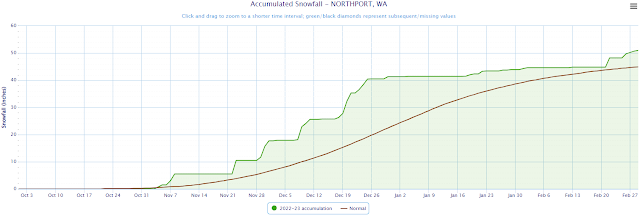
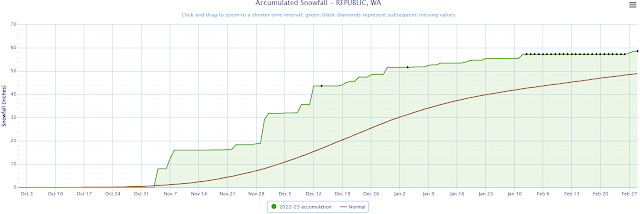
Additional seasonal accumulated snowfall graphs: Here are a few more accumulated snowfall graphics for various stations across central and eastern Washington as well as north Idaho. Hopefully you find one that is representative of where you live.


Saturday, December 31, 2022

Inland Northwest Weather Year in Review 2022

This year the Inland Northwest had no shortage of memorable and impactful weather events. As we welcome a new year, let's look back at some of the bigger weather events of 2022 across the Inland Northwest.


In January there was a massive snow event across Central Washington. This storm dumped 2 to 3 feet of snow on Wenatchee, Leavenworth, and the Methow Valley. Avalanches closed the Cascade mountain passes for days. A blizzard on the Waterville Plateau stranded motorists.


April was a busy month. A wind storm from a strong cold front produced wind gusts to 60 mph bringing trees down in Spokane, Pullman, and Lewiston. Winds also pushed an early season wildfire near Nespelem, WA. Blowing dust darkened the sky in the Lewiston-Clarkston Valley.


April was also a cold month. The entire Pacific Northwest had a cold April. Wenatchee had its coldest April on record including a big snowstorm on the 14th. Fruit trees in central Washington struggled to bloom and pollinate on time, as many other agriculture communities saw impacts from the cold and late blooming crops.


May brought two tornadoes to the Spokane area. May 6, a pair of EF-0 tornadoes produced damage within the city limits. Washington tornadoes are rare, but they do occur. The month of May is one of our most common months for tornadoes.


June saw flooding. A late Spring snowpack and frequent rain in June caused river flooding. The heaviest rain of the month fell on June 13 and 14 causing flooding in southeast Washington and the Idaho Panhandle. The Pend Oreille River was above flood stage for several weeks.


Following the flooding from June, July 4th had the flash flood in Conconully, WA. Slow moving thunderstorms occurred over the 2021 Muckamuck burn scar and send much and water into the small town of Conconully in Okanogan county, WA.


August was a busy severe weather month. Severe hail storms on August 11. Parts of eastern Washington and nearby Idaho were pounded by large hail and damaging thunderstorm winds. Swaths of crops were ruined. Cars and homes were also severely damaged by hail of golf ball size (2.75 inches) or larger. 


As to be expected, our fire season showed up. September and October saw lots of smoke. Degraded air quality was common in Chelan county and parts of far north Idaho late in Summer and into the Fall. Places like Leavenworth experienced smoke for weeks until Fall rains arrived. 


November started off on a snowy note. November 6 and 7 heavy snow. A swath of deep snow fell across north central and northeast Washington into far north Idaho. Many communities measured over a foot of new snow. Omak got up to 17 inches and a location near Republic got nearly 3 feet! People in Athol, Idaho saw 19 inches.


Closing out November, November 30 saw more heavy snow. Most of Washington state and the Idaho Panhandle got snow when this large weather system moved inland. Spokane got 7.5 inches, breaking  the snowfall record for the date. The Cascade mountains saw 1 to 2 feet of heavy snow.


Here's to a new year ahead with many more weather events to document and look forward to!

Monday, November 28, 2022

Update on the Wednesday Winter Storm


Yesterday's blog hopefully gave you a taste of the variability in the weather computer forecasts for the upcoming winter storm.  Late last week, the computer models had pretty good agreement on a heavy snowfall event.  But over the weekend, a few new scenarios developed for how much snow we will get and when.  Let's take a look at the latest forecasts to see if we have any new scenarios or possibly agreement.

There is good agreement on the start of the snow event, so we have high confidence for this. 

  • Light snow will start in the Cascades late Tuesday afternoon.
  • North-central Washington will get about an inch of snow Tuesday evening.
  • Snow should reach the Spokane/CdA metro by Wednesday morning.  
  • North-central Washington should have 3-5" of snow by sunrise Wednesday.
  • Snow will spread over the remainder of the Inland NW by about 10am Wednesday.
How much snow falls during Wednesday is still quite variable.  Most of the computer forecasts still point to the heaviest snowfall along a line from about Lake Chelan, to Keller, to Deer Park, to Sandpoint.  Here's the ECMWF forecast for this time period:


Most readers will note that the ECMWF still has a very low snowfall amount forecast for Spokane (i.e. 2.7").  It's been fairly consistent over the past 2 days of predicting a "low snow" event for the metro.

Compare that to the GFS, which has really stuck to its guns, saying that Spokane is going to get nailed with snow (11.5"):


What's interesting is that the 2 models have a similar overall pattern, with the heavy snow band oriented west-to-east.  The difference is in the exact placement.  If that band is farther north, Spokane will have a ho-hum event.  Farther south, and we're talking significant snow for the metro area.

Here's some other computer forecasts for that same time period:


Again all have the same basic overall pattern, just a little different in the exact location of the heaviest band of snow.  Here's a summary table for a few locations, along with the average of those 5 computer models.


ECMWF

GFS

Canadian

NAM

UKMET

Average

Spokane

2.5”

11.5”

5.7”

2.6”

5.2”

5.5”

Sandpoint

7.7”

5.1”

6.7”

3.7”

8.0”

6.2”

Pullman

3.2”

2.0”

5.8”

2.9”

5.3”

3.8”

Omak

2.9”

2.2”

1.9”

6.9”

3.0”

3.4”

Wenatchee

4.9”

2.1”

1.6”

3.2”

1.4”

2.6”

Moses Lake

1.6”

2.2”

1.3”

1.3”

1.7”

1.6”

Lewiston

0.7”

1.3”

0.5”

0”

0.2”

0.5”


Remembering from the previous blog, all of these numbers we shown you are calculated using a 10:1 ratio of snow vs liquid.  Given how cold temperatures are, the ratio will most likely be closer to 15:1 or even higher.  So all of these numbers should be increased about 50% to get a more realistic snowfall forecast.

For Thursday, the snow slowly sags into southeast Washington the southern Idaho Panhandle, as it ends in north-central and northeast Washington.  Pullman and Lewiston have their best chances for heavy snow on Thursday, with an additional 3-5" possible.

Looking at these forecasts (as well as other models not shown here), and adding local forecaster experience, this is the current official forecast for snowfall.


One other factor to address is that temperatures on Wednesday will get warmer. This isn't unusual.  A strong low pressure system off the WA/OR coast will bring warmer air northward.  The forecast high temperature at Spokane Airport is 33F, and 35F for downtown, which could limit snow accumulations in the afternoon a bit.  That won't be an issue for folks living to the north of Spokane.