Friday, May 10, 2019

Fire and Summer Outlook

With the warm and dry start to May, you may be already thinking about summer and what kind of fire season lies ahead.  There have already been some folks comparing this year to 2015.  In this blog we will discuss the outlook for the upcoming fire/summer outlook so let's get to it!

2015 Fire Season

Let's begin with a comparison of this year to 2015.  For those new to the area, 2015 was an extremely active fire season burning over 1 million acres across Washington State.  That year featured a very low snow pack, a record hot June for many areas, and a dry summer.  This primed the land for several large fires when dry lightning and windy weather entered the region in August. To put that year in perspective, here are acres burned by year since 1970 for our region which includes most of Central and Eastern Washington and the North Idaho Panhandle.

Number of acres burned each year since 1970 in Spokane Fire Area which includes most of Central and Eastern Washington and the Idaho Panhandle.

So while over a million acres burned in Washington State, our region (most of Central and Eastern Washington and north Idaho) was hit especially hard with over 900,000 acres burned.  We can also see from this graph that we have had several active fire seasons since 2012.

2019 versus 2015

With some folks comparing this year to 2015, we need to look at some comparison maps of where we stand now compared to 2015.  Shown below are images from April 1st when snow pack typically peaks.  First image is 2019 and then 2015.

April 1st, 2019 SWE % of Normal

April 1st, 2015 SWE % of normal

As one can see in 2015, snow pack was in far worse shape on April 1st.  What does our current snow pack look like as of May 9th compared to around this same time in 2015?

May 9, 2019 SWE % of normal


May 11th, 2015 SWE % of normal.

Our snow pack in 2015 was again far worse compared to this year.

What about precipitation?


Conditions are actually drier this year compared to 2015 over the Cascades, northern Washington, and the Idaho Panhandle and wetter over parts of the Columbia Basin and SE Washington.  But is has been exceptionally dry over the past 30 days over most of the region as noted below.


Does low snow pack and dry winter/spring mean a bad fire year?

Let's tie this all together.  Does a below normal snow pack and a dry winter/spring mean another bad fire season?  Not necessarily.  We did a correlation to number of acres burned each season since 1970 and compared it to several factors including April 1st snow pack, October-May precipitation, number of lightning caused fires, and late spring/summer temperatures.

The most important factor is May-August temperatures followed by number of lightning caused fires.  This makes sense as a hotter summer typically brings dry conditions and makes the grass and timber readily available to burn.  But still this correlation by itself isn't very high as number of acres burned depends how many times a critical fire weather pattern sets up as hot temperatures won't start fire by itself.  2015 is a prime example as that season wasn't exceptionally busy locally until August 10th when the critical pattern set up with dry lightning and several rounds of windThe fires that had a start date between Aug 11-25 consumed 834,623 acres.  It is worth noting that mountain snow pack on April 1st has a very low correlation and amount of winter/spring precipitation has nearly 0 correlation to number of acres burned during fire season.  So this summer we will be closely monitoring summer temperatures and watching critical fire weather patterns.

Pattern change
The dry weather over the past 30 days will result in elevated chances for fire spread this weekend as the winds begin to increase on Sunday (May 12th).  The pattern looks to change towards the end of next week with wetter than normal conditions favored May 16-20th.


Climate Prediction Center 6-10 day precipitation outlook valid May 16-20, 2019

Summer/Fire Outlook
So since summer weather ultimately decides what kind of fire season we'll have based on the local study mentioned above, what can we expect?  Let's begin with temperatures.  No surprise here with elevated odds of warmer than normal.

CPC June-August 2019 Temperature Outlook issued April 18th, 2019

Why is this no surprise?  Because our summers have been trending warmer at each location since 1900 as shown below.

Summer (June-August) temperature trends since 1900 as plotted from the OWSC Trend Analysis Tool

The big red circles show a significant warming trend, while the smaller red circles also show warming, but the trend is considered insignificant in terms of long term trends.  The plot above as well as the few that follow can be generated from the Office of Washington State Climatologist Trend Analysis tool found here 

Below is a graph showing average temperatures in Spokane since 1900.  The past four summers are highlighted in red and have been noticeably warm. 


What about precipitation this summer?  The summer's of late have been quite dry, especially in Spokane as shown below.


The past four summers (June-August) in Spokane have brought less than 1.00" of precipitation, something that hasn't been accomplished for more than two consecutive summers since 1900 until now.  Normal June-August precipitation is 2.48".  Will we make it five in a row?  Let's see what the Climate Prediction Center is saying.

CPC June-August 2019 Precipitation Outlook issued April 18th, 2019

Slightly elevated odds of wetter than normal conditions for SE Washington into the Idaho Panhandle with Equal Chances elsewhere.  What kind of pattern would result in this?

NMME Forecast issued early May of precipitation anomalies June-August 2019

The pattern would be high pressure off the coast deflecting systems into Alaska and down into Eastern WA/N Idaho and the Northern Rockies as the NMME (National Multi-Model Ensemble) shows.  This could give Eastern WA/N Idaho periods of cooler and showery conditions.  But getting this pattern nailed months in advance is nearly impossible for the models to get right.  That area of high pressure could set up further east over our region giving hot/dry weather.  Or it could set up slightly further west providing occasional rounds of cool/wet weather.  There is low confidence of this occurring.

Here are the official National Fire Outlooks for July and August.

National Fire Outlook issued by NIFC May 1st valid for July 2019

National Fire Outlook issued by NIFC May 1st valid August 2019
These get updated on the 1st of each month.  For the latest outlooks, go here

Summary
Given all the factors that came together in the 2015 fire season, 2019 is likely to not be a repeat but could still be an above normal season.  The dry weather pattern as of late is expected to change in the May 16-20 period with wetter than normal conditions as well as cooler temperatures.  Going into summer warmer than normal temperatures are favored while precipitation is more of a wild card.  The Fire Potential Outlook for this summer favors above normal for western Washington, and the northern valleys and mountains with near normal potential elsewhere.  

Friday, March 8, 2019

Will astronomical spring arrive on schedule?

Everyone wants to know when the cold spell will end.  With another day of below normal temperatures today, our current streak of below normal temperatures will reach 34.  This number will continue to grow but could astronomical spring actually arrive on schedule?  March 20th marks the official first day of spring.  What does the weather pattern look like as we approach this date?  And what is our normal temperature anyway?  Let's dive into it.

Let's begin with this weekend.  Here is a plot of temperature anomaly on Saturday from one model.

12z/Mar 7th GEFS forecast of 850mb temperature anomaly valid 4 PM PST March 9th.

 You can see lots of blue over our region indicating the continued cooler than normal temperatures over all of the west.

But changes may be in store come later next week.  Here is what the GFS model shows for Thursday, March 14th.

00z/Mar 8th GFS model forecast of 500mb heights and 250mb winds (image) valid 4 PM PST March 14th, 2019

You can see an active jet stream in the west and central Pacific but high pressure starting to build near our neck of the woods.  High pressure typically brings milder temperatures in March but this will take some time. The snow cover, and melting snow will likely provide a favorable environment for night time fog development especially in the early stages of this ridge which should keep the actual warming tempered with below normal temperatures favored to continue through next week.

March 17th Pattern

What about further out?  This model shows high pressure becoming stronger March 17th.


00z Mar 8th GFS model forecast of 500mb heights and 250mb winds (image) valid 4 PM PST March 17th, 2019

This solution would support a warming trend, but again in the lower elevations fog and low clouds could limit the warming to some degree.  But we are getting now into mid March, and the sun angle favors low clouds not lasting through the day and the lower level cold air should moderate.

But one model solution 10 days out can easily not pan out.  So we need to look at other models and what are called ensemble forecasts to get a better idea of possibilities far out into the forecast.

Let's look at the Canadian Ensemble Mean forecast first for March 17th.

12z Mar 7th CMCE forecast of 850mb temperature anomaly valid 4 PM PST March 17th.

Whoa!  This model shows temperatures (at least in the mountains) warming to slightly above normal.

What about the GFS Ensemble mean (GEFS)

12z Mar 7th GEFS forecast of 850mb temperature anomaly valid 4 PM PST March 17th.

This solution isn't as warm keeping our temperatures slightly below normal.  But just slightly, with temperatures warmer than they are now.

March 20th - First day of Spring

Now we are really getting far out into the forecast.  Models usually aren't very reliable this far out but sometimes the model ensemble means can give a glimpse of where the warm and cold anomalies may set up on a regional scale.  What are the models showing?  We will start with the Canadian Ensemble Mean again.

12z Mar 7th CMCE forecast of 850mb temperature anomaly valid 4 PM PST March 20th.

Haven't seen these colors in awhile.  The Canadian Ensemble Mean has a warmer than normal air mass over us.  What about the GFS Ensemble Mean?

12z Mar 7th GEFS forecast of 850mb temperature anomaly valid 4 PM PST March 20th.

Wow, seeing some warm colors from this model (above) as well.

Now looking at the latest 8-14 Day Temperature Outlook (image below) from the NWS Climate Prediction Center (CPC) there is a favorable trend toward warmer temperatures along the west coast and chances of having colder than normal temperatures are less.  It looks as if the cold anomaly that has had much of the U.S. in its grips is moving farther out of the west giving the region a break from well below normal temperatures.


Precipitation looks to have a better chance of being minimal going into the middle of March.


So, you may be asking what is normal for temperatures in this region?  After all we've been below normal for a little over a month.  Here are the normal highs for the first day of spring

March 20th normal high temperature

Wouldn't these temperatures be pleasant?  The increasing March sun angle is in our favor.  Maybe we will get there around the first day of Spring or shortly after.

Thursday, February 28, 2019

February recap - Records broken

NOTE: Blog updated 315 AM Mar 2nd with final numbers for February.  LaCrosse was missing data from Feb 27-28.
--------------------------------------------------------------------------------------------------------------------------

What a month it has been!  In this blog will highlight some of the top events of the month and look at how the month finished by the numbers.  Hint - several snow records broken.

Feb 9th Blizzard

Strong winds and snow brought blowing and drifting snow to much of the region.  This was especially true on the Waterville Plateau and Moses Lake area where blizzard conditions brought scenes like this on Highway 2 east of Waterville.

Highway 2 east of Waterville - Photo courtesy of WADOT

Road closures were numerous, with a lot of this going on to get the roads back open.

State Route 27 near Colfax - Photo courtesy of WSDOT

Late Feb 11-Feb 12 Bonners Ferry breaks 2 day snow record

A sharp frontal boundary over Bonners Ferry, Idaho resulted in a band of very heavy snowfall.  This brought a record 2 day snowfall as noted below with 24.7".  These are morning 24 hour observations and thus the combined total is from the Feb 12th and 13th reports.


Feb 25-27th Columbia Basin and Palouse snow/drifting snow

Despite being so late in the month, more rounds of snow moved in.  The snow remained of the powder variety making it very susceptible to drifting as the winds picked up.  Several road closures occurred as snow drifts reached 12 feet high in spots which made it a challenge to open roads like the picture below shows.  Yes, that's a stop sign in the picture.  

State Route 27 - Photo courtesy of WSDOT 

 February by the numbers

Snow


 Let's begin with snow.  Several sites finished in the top 5 list of total snowfall as shown below.


Total snowfall broke a record at Lewiston, La Crosse, Rosalia, Wenatchee, Lind, and Saint Maries.  Spokane and Coeur d'Alene finished in 2nd place.  Note for some locations we are awaiting numbers for the last few days of the month so the results above are not final.

How about number of days of February snow?  Many records broken here as well.


How about the amount of snow on the ground for February 28th?  Surprisingly while the snow is deep in many spots, records for the date were hard to find.  However, Lewiston and Spokane made the list.  Lewiston smashed its previous record.


Note for Spokane we have about the same amount of snow on the ground now as we had on February 28th, 1969.  Note the snow depth for this day in 1969 was missing, but showed 17" the day before and 16" the day after.

Now there was one part of our region where total snow this month wasn't a big deal.  Where you ask?  Parts of North Central Washington including Omak and Winthrop finished drier than normal in terms of precipitation amounts.


Yet one last record related to precipitation to mention here.  Again for Lewiston where 3.42" of total precipitation has fallen for the month breaking the monthly February precipitation record.

Temperatures


Now how about the cold temperatures?


Note that several stations finished in the top 10, but none were coldest on record.  Again, these numbers are preliminary since we are awaiting some final numbers for the past few days for some locations. As you can see February 1936 was quite the brutally cold month across the region.

How much colder compared to normal has it been?  Here is a map below


Most places are in the blue shading (10-15F below normal).  Montana was especially in the freezer this month.


Wednesday, February 20, 2019

What is our snow load?

Are you wondering about the weight of snow on your roof?  We have received a few questions lately regarding this topic, so let's take a look.

When looking for the possibility of a roof collapsing, we want to take into consideration the different weights that snow may hold due to water content.  Light, dry snow weight ranges from 1 to 3 lb/ft² while wet, heavy snow can reach up to 21 lb/ft².  Once the snow has fallen, the snow can accumulate more liquid through humidity, and any additional rain that has fallen.  Snow tends to act like a sponge and even though it may look like the snow depth is decreasing, the snow is actually absorbing the excess water.  In other words, the depth of the snow can be misleading compared to the weight of the snow.

For most valley areas (excluding the Cascades and up near the Canadian border) there was little to no snow on the ground to start the month off.   When looking at the maps below, we can see the weight of the snow (in lbs/square foot) as worst case scenario being placed on the roofs in terms of February contributions.  This means that if there was no day time melting that occurred during the month, there could potentially be up to the stated weight on the roofs assuming no snow was on your roof to begin the month which was the case for most of these areas.  But chances are that there was daytime melting that was occurring especially given the higher February sun angle bringing the total weight down.

Snow load weight in lb/ft² - February 20th, 2019

As you can see under 20 pounds per square foot for all reports listed except for near Plummer, ID.  These values are much less than the December 2008 values that brought roof collapses to part of the region including Spokane.

Here are some suggested signs of snow load problems
  • Cracks in the walls that were not previously there or have extended
  • Frequent popping, creaking, or cracking sounds
  • The roof visibly sagging
  • Doors, windows that are noticeable harder to open or close, especially interior doors

For more information about structural snow loads, feel free to visit FEMA Snow Load Safety Guide

Monday, February 18, 2019

Two more snow events this week

The wild February continues on with more snow for the upcoming week.  Will February snow records be threatened?  When will the snow fall?  How much?  What will the impacts be? Let's get to it.

First, let's take a look at how much snow has fallen so far this February based on reports we've received through the 17th along with the February record for the entire month.


As you can see, most places still need quite a bit of snow to threaten the February record but more is coming. At this point Saint Maries, La Crosse, and Nez Perce have the best chances of breaking the record.

Here is where Spokane ranks as of February 17th with the top 10 February events listed


There is a very good chance Spokane will rise into 2nd place by the end of this week.

Now let's take a look at the week ahead.

Tuesday/Wednesday Storm

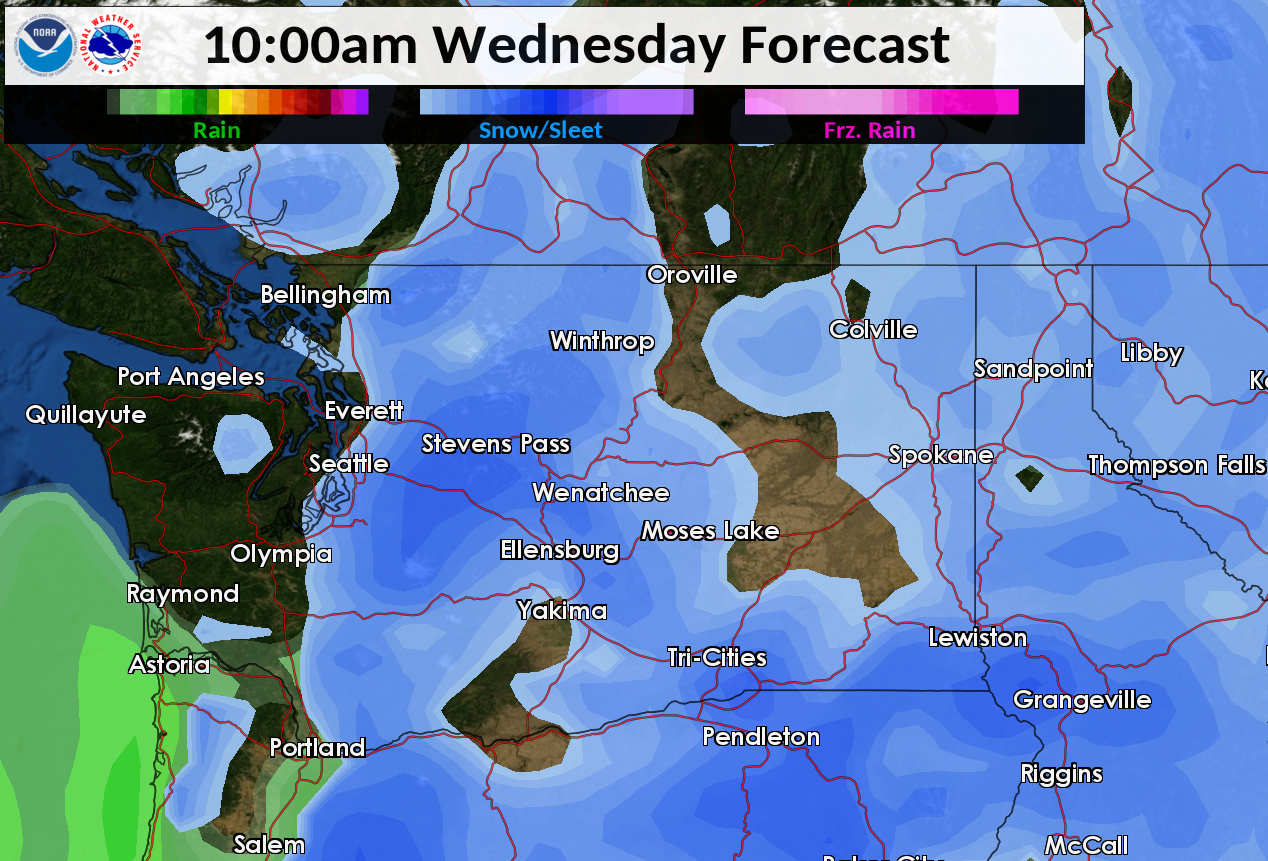
Another storm arrives Tuesday afternoon and lingers into Wednesday.  Here is one model depiction of the weather pattern.

00z/18th GFS Model forecast of 500mb heights and 700-500mb Relative Humidity valid 4 AM PST Feb 20th, 2019

This pattern sure looks familiar.  Strong high pressure off the coast with another storm dropping in from the northwest.  Note all the green shade over the region indicating high moisture content and thus the snow.

Here is the same model showing precipitation timing of the storm


Snow looks to begin Tuesday afternoon, likely impacting the Tuesday evening commute.  Now for the rest of the images.


This will be a prolonged snow event for some locations with the longest duration expected over SE Washington.   Expect impacts to the Tuesday evening and Wednesday morning commute. Here is our forecast as of Monday morning for expected snowfall totals.


Models have been pretty consistent and are in agreement with this storm so there is moderate confidence in these amounts.  As always we will continue to fine tune the forecast for this storm.  Please go to our web site here for the latest forecast for your area.

Friday/Saturday Storm

There will be a short break on Thursday before yet another system arrives.  Does the weather map look familiar?

00z/18th GFS Model forecast of 500mb heights and 700-500mb Relative Humidity valid 4 PM PST Feb 22nd, 2019

Models are coming into good agreement of more snow, but differ with the details of how long this storm remains over the region.  This storm has the potential to produce as much if not more snow as the Tuesday/Wednesday one.  Stay tuned!